
Technical Support & Resources
Visit our FAQ
Contact Us
Toll Free Phone (USA and Canada Only): (888) 526-5351
Direct Phone: (734) 975-3888
Product Categories
Product Type
Application
HMG-CoA Reductase (human recombinant)
Item No. 14944
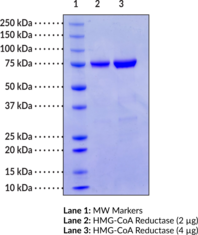
Technical Information
- 3-hydroxy-3-methylglutaryl-Coenzyme A Reductase
- HMGCR
- HMGR
Shipping & Storage Information
Recommended Products
Certificates of Analysis & Batch Specific Data
Provide batch numbers separated by commas to download or request available product inserts, QC sheets, certificates of analysis, data packs, and GC-MS data.
Product Description
HMG-CoA reductase (HMGR) is a highly regulated enzyme found on the endoplasmic reticulum (ER) membrane. It is bound to the ER membrane by a multi-pass 339 amino acid N-terminal transmembrane domain while the carboxy terminal catalytic region projects into the cytosol.1,2 HMGR is controlled by feedback regulation from sterols and non-sterol metabolites derived from mevalonate.2,3,4 Binding of cholesterol derived from internalized LDL receptors suppresses HMGR. The enzyme is responsible for catalyzing the rate-limiting step in cholesterol biosynthesis. Mevalonate, which is converted to isopentenyl pyrophosphate, is the building block for cholesterol and non-sterol isoprenoids. The four-electron reduction of HMG-CoA catalyzed by HMGR to form mevalonate is the committed step in the biosynthesis of sterols and isoprenoids.5 Potent inhibitors of HMGR, collectively called statins, are effective in lowering mortality due to hypercholesterolemia by lowering serum cholesterol levels.6
WARNING This product is not for human or veterinary use.
References & Product Citations
1. Crystal structure of the catalytic portion of human HMG-
2. Human 3-
3. Multivalent feedback regulation of HMG CoA reductase, a control mechanism coordinating isoprenoid synthesis and cell growth. J. Lipid Res. 21(5), 505-517 (1980).
4. Accelerated degradation of HMG CoA reductase mediated by binding of insig-
5. Structural mechanism for statin inhibition of HMG-
6. Safety of statins. Curr. Opin. Lipidol. 19(6), 558-562 (2008).
Contact Info
Cayman Chemical1180 East Ellsworth RoadAnn Arbor, Michigan 48108 USAToll Free: (800) 364-9897(USA and Canada only)Fax: (734) 971-3640


