
Technical Support & Resources
Information provided in the product description is from published literature. Due to the nature of scientific experimentation, your results (e.g., selectivity and effective concentrations) or specific application for this product may differ. If you have questions about how this product fits your application, please contact our technical support staff.
Visit our FAQ
Contact Us
Toll Free Phone (USA and Canada Only): (888) 526-5351
Direct Phone: (734) 975-3888
Product Categories
Application

Technical Information
- Atebrine
- Mepacrine
Shipping & Storage Information
Recommended Products
Certificates of Analysis & Batch Specific Data
Provide batch numbers separated by commas to download or request available product inserts, QC sheets, certificates of analysis, data packs, and GC-MS data.
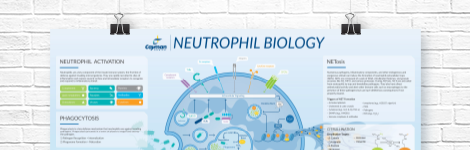
Neutrophil Biology Wall Poster
Explore how neutrophils shape the immune response in health and disease. This poster highlights neutrophil pathogen defense mechanisms, including phagocytosis, degranulation, and NETosis, as well as neutrophil roles in inflammation and NET-associated pathologies.
DOWNLOAD NOWProduct Description
Quinacrine is an acridine compound with diverse biological activities that has also been used as a stain for DNA and RNA in fixed cells and for fluorescent tracking of acidic vesicles, such as lysosomes, in live cells.1,2,3,4 It has anti-protozoal properties, potently prevents misfolding of prion protein (EC50 = 0.3 μM), blocks voltage-dependent sodium channels (IC50 = 3.3 μM), and inhibits aldehyde oxidase (IC50 = 3.3 μM).1,2,3,4 Quinacrine is also an effective riboflavin antagonist, associating with the riboflavin-binding protein (Ki = 6.7 μM), and an inhibitor of P-glycoprotein (EC50 = 14.4 μM).5,6 At much higher doses, quinacrine inhibits phospholipase A2 activity.7,8 Quinacrine binds to nucleic acids and has been used in fixed cells to stain DNA and RNA with excitation/emission maxima of 436/525 nm, respectively.9 In live cells, it is taken up into acidic vesicles, such as lysosomes, and can be used to for long-term imaging with an excitation of 458 nm and emission in the 470-580 nm range.10
WARNING This product is not for human or veterinary use.
References & Product Citations
1. Drug targets and mechanisms of resistance in the anaerobic protozoa. Clin. Microbiol. Rev. 14(1), 150-164 (2001).
2. Antimalarial drug quinacrine binds to C-
3. [3H]Batrachotoxinin A 20α-
4. Aldehyde oxidase: An enzyme of emerging importance in drug discovery. J. Med. Chem. 53(24), 8441-8460 (2010).
5. Bioanalytical screening of riboflavin antagonists for targeted drug delivery -
6. Ranking of P-
7. Inhibitors of brain phospholipase A2 activity: Their neuropharmacological effects and therapeutic importance for the treatment of neurologic disorders. Pharmacol. Rev. 58(3), 591-620 (2006).
8. Role of phospholipase A2 activation and calcium in CYP2E1-
9. Table 2.3. Fluorescent and Luminescent Probes for Biological Activity: A Practical Guide to Technology for Quantitative Real-Time Analysis 33 (1999).
10. Evaluation of acridine orange, LysoTracker Red, and quinacrine as fluorescent probes for long-
Contact Info
Cayman Chemical1180 East Ellsworth RoadAnn Arbor, Michigan 48108 USAToll Free: (800) 364-9897(USA and Canada only)Fax: (734) 971-3640


