
Technical Support & Resources
Information provided in the product description is from published literature. Due to the nature of scientific experimentation, your results (e.g., selectivity and effective concentrations) or specific application for this product may differ. If you have questions about how this product fits your application, please contact our technical support staff.
Visit our FAQ
Contact Us
Toll Free Phone (USA and Canada Only): (888) 526-5351
Direct Phone: (734) 975-3888

Technical Information
- Fibronectin Inhibitor
- H-
Arg- Gly- Asp- Ser- OH
Shipping & Storage Information
Recommended Products
Certificates of Analysis & Batch Specific Data
Provide batch numbers separated by commas to download or request available product inserts, QC sheets, certificates of analysis, data packs, and GC-MS data.
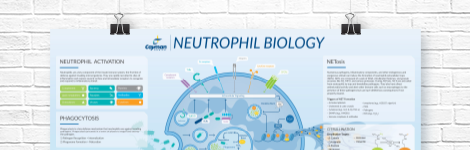
Neutrophil Biology Wall Poster
Explore how neutrophils shape the immune response in health and disease. This poster highlights neutrophil pathogen defense mechanisms, including phagocytosis, degranulation, and NETosis, as well as neutrophil roles in inflammation and NET-associated pathologies.
DOWNLOAD NOWProduct Description
RGDS peptide is a tetrapeptide found on fibronectin, fibrinogen α, and von Willebrand factor, but not vitronectin or collagen.1,2 RGDS interacts with α5β1 and αVβ3 integrins.3 This tetrapeptide interferes with the attachment of cells to fibronectin-
WARNING This product is not for human or veterinary use.
References & Product Citations
1. Inhibition of platelet adhesion to fibronectin, fibrinogen, and von Willebrand factor substrates by a synthetic tetrapeptide derived from the cell-
2. Cell attachment activity of fibronectin can be duplicated by small synthetic fragments of the molecule. Nature 309(5963), 30-33 (1984).
3. RGD-
4. Mechanism of Pneumocystis carinii attachment to cultured rat alveolar macrophages. J. Clin. Invest. 86(5), 1678-1683 (1990).
5. Fibronectin tetrapeptide is target for syphilis spirochete cytadherence. J. Exp. Med. 162(5), 1715-1719 (1985).
6. The tetrapeptide analogue of the cell attachment site of fibronectin inhibits platelet aggregation and fibrinogen binding to activated platelets. The Journal of Biological Chemisty 260(22), 11891-11894 (1985).
7. Inhibition of fibronectin binding to platelets by proteolytic fragments and synthetic peptides which support fibroblast adhesion. The Journal of Biological Chemisty 260(7), 3931-3936 (1985).
8. The integrin-
9. Synthetic RGDS peptide attenuates lipopolysaccharide-
Contact Info
Cayman Chemical1180 East Ellsworth RoadAnn Arbor, Michigan 48108 USAToll Free: (800) 364-9897(USA and Canada only)Fax: (734) 971-3640


