
Technical Support & Resources
Information provided in the product description is from published literature. Due to the nature of scientific experimentation, your results (e.g., selectivity and effective concentrations) or specific application for this product may differ. If you have questions about how this product fits your application, please contact our technical support staff.
Visit our FAQ
Contact Us
Toll Free Phone (USA and Canada Only): (888) 526-5351
Direct Phone: (734) 975-3888

Technical Information
- NSC 66544
- NSC 405702
- NSC 405703
- NSC 405704
- NSC 405705
- NSC 405706
- TTFA
Shipping & Storage Information
Recommended Products
Certificates of Analysis & Batch Specific Data
Provide batch numbers separated by commas to download or request available product inserts, QC sheets, certificates of analysis, data packs, and GC-MS data.
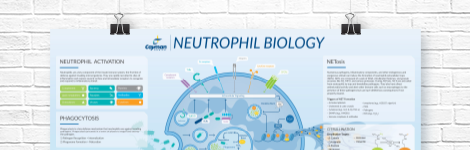
Neutrophil Biology Wall Poster
Explore how neutrophils shape the immune response in health and disease. This poster highlights neutrophil pathogen defense mechanisms, including phagocytosis, degranulation, and NETosis, as well as neutrophil roles in inflammation and NET-associated pathologies.
DOWNLOAD NOWProduct Description
2-Thenoyltrifluoroacetone (TTFA) is an inhibitor of respiration in animals and bacteria. In animals, TTFA binds at the quinone reduction site of succinate:ubiquinone oxidoreductase (SQR; Complex II), preventing ubiquinone from binding.1,2 It inhibits NADH fumarate reductase in bacteria.3,4 TTFA also inhibits photosystem II in plants and NADH-ubiquinone oxidoreductase of the virus Vibrio cholerae, decreasing cholera toxin production.5,6 This compound is also a chelator of metals, including lanthanum, zirconium, hafnium, and neodymium.
WARNING This product is not for human or veterinary use.
References & Product Citations
1. Crystal structure of mitochondrial respiratory membrane protein complex II. Cell 121(7), 1043-1057 (2005).
2. Structural and computational analysis of the quinone-
3. Inhibitor probes of the quinone binding sites of mammalian complex II and Escherichia coli fumarate reductase. The Journal of Biological Chemisty 271(35), 21020-21024 (1996).
4. Characterization of the respiratory chain of Helicobacter pylori. FEMS Immunol. Med. Microbiol. 24(2), 169-174 (1999).
5. Inhibition of photosystem II of spinach by the respiration inhibitors piericidin A and thenoyltrifluoroacetone. Biosci. Biotechnol. Biochem. 66(9), 1925-1929 (2002).
6. Inhibition of the sodium-
Defining a pharmacological inhibitor fingerprint for oxytosis/ferroptosis. Free Radic. Biol. Med. S0891-5849(21), (2021).
A potent and selective small-
Contact Info
Cayman Chemical1180 East Ellsworth RoadAnn Arbor, Michigan 48108 USAToll Free: (800) 364-9897(USA and Canada only)Fax: (734) 971-3640


