
Technical Support & Resources
Information provided in the product description is from published literature. Due to the nature of scientific experimentation, your results (e.g., selectivity and effective concentrations) or specific application for this product may differ. If you have questions about how this product fits your application, please contact our technical support staff.
Visit our FAQ
Contact Us
Toll Free Phone (USA and Canada Only): (888) 526-5351
Direct Phone: (734) 975-3888

Technical Information
- CFTR(inh)-
172 - Cystic Fibrosis Transmembrane Conductance Regulator Inhibitor 172
Shipping & Storage Information
Recommended Products
Certificates of Analysis & Batch Specific Data
Provide batch numbers separated by commas to download or request available product inserts, QC sheets, certificates of analysis, data packs, and GC-MS data.
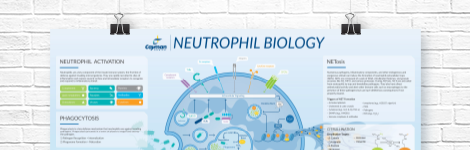
Neutrophil Biology Wall Poster
Explore how neutrophils shape the immune response in health and disease. This poster highlights neutrophil pathogen defense mechanisms, including phagocytosis, degranulation, and NETosis, as well as neutrophil roles in inflammation and NET-associated pathologies.
DOWNLOAD NOWProduct Description
The cystic fibrosis (CF) gene encodes a cAMP-regulated chloride channel, the CF transmembrane conductance regulator (CFTR).1 CFTR inhibitor-172 is a thiazolidinone that selectively blocks the CFTR channel (Ki = 300 nM) in a voltage-independent manner.2 It appears to directly modulate the gating of chloride at the channel and does not prevent elevation of cAMP or inhibit other pumps or channels.2,3 In mice, CFTR inhibitor-172 prevents cholera toxin-
WARNING This product is not for human or veterinary use.
References & Product Citations
1. The cystic fibrosis mutation G551D alters the non-
2. Thiazolidinone CFTR inhibitor identified by high-
3. Altered channel gating mechanism for CFTR inhibition by a high-
4. Luminally active, nonabsorbable CFTR inhibitors as potential therapy to reduce intestinal fluid loss in cholera. The FASEB Journal 20(1), 130-132 (2006).
5. Small-
6. CFTR is involved in the fine tuning of intracellular redox status: Physiological implications in cystic fibrosis. Am. J. Pathol. 181(4), 1367-1377 (2012).
7. CFTR mediates apoptotic volume decrease and cell death by controlling glutathione efflux and ROS production in cultured mice proximal tubules. Am. J. Physiol. Renal Physiol. 298(2), F435-F453 (2010).
8. Role of CFTR in oxidative stress and suicidal death of renal cells during cisplatin-
Contact Info
Cayman Chemical1180 East Ellsworth RoadAnn Arbor, Michigan 48108 USAToll Free: (800) 364-9897(USA and Canada only)Fax: (734) 971-3640


