
Technical Support & Resources
Visit our FAQ
Contact Us
Toll Free Phone (USA and Canada Only): (888) 526-5351
Direct Phone: (734) 975-3888
Product Categories
Product Type
Application
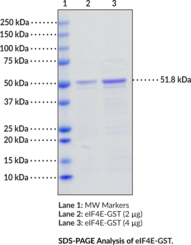
eIF4E (human recombinant; GST-tagged)
Item No. 15564
Technical Information
- Eukaryotic Translation Initiation Factor 4E
- mRNA Cap-
binding Protein
Shipping & Storage Information
Recommended Products
Certificates of Analysis & Batch Specific Data
Provide batch numbers separated by commas to download or request available product inserts, QC sheets, certificates of analysis, data packs, and GC-MS data.

Visit Our Cancer Resource Center
Find Tools & Resources to Study the Hallmarks of Cancer
- Cancer cell signaling & regulation
- Cancer metabolism
- Tumor microenvironment
Product Description
Eukaryotic translation initiation factor 4E (eIF4E) is a component of the eIF4 complex that specifically binds to the methy-7-guanosine cap structure at the 5’ end of eukaryotic mRNA to initiate translation.1,2,3 Nuclear eIF4E promotes export of mRNAs that contain the eIF4E sensitivity element (4E-SE) to the cytosol while cytosolic eIF4E, in a complex with eIF4A and eIF4G1/eIF4G3, mediates recruitment of mRNAs to the ribosome to initiate cap-dependent translation.4,3 eIF14E activity is regulated by eukaryotic translation initiation factor 4E-binding proteins (4E-BPs), which bind eIF4E to prevent eIF4 complex assembly and subsequent translation.3 Overexpression of eIF4E is observed in approximately 30% of human malignancies, including breast, colon, and head and neck carcinomas, and acute myeloid leukemias, particularly M4 and M5 subtypes, as well as prostate cancers.5,6,3 Increased eIF4E expression leads to increased translation of oncogenic mRNAs, such as those encoding VEGF and cyclin D1, and contributes to cancer cell survival and proliferation.
WARNING This product is not for human or veterinary use.
References & Product Citations
1. Interferon-
2. eIF4G dramatically enhances the binding of eIF4E to the mRNA 5'-
3. Structure and functions of the translation initiation factor eIF4E and its role in cancer development and treatment. J. Genet. Genomics 45(1), 13-24 (2018).
4. Cocrystal structure of the messenger RNA 5' cap-
5. The oncogene eIF4E: Using biochemical insights to target cancer. J. Interferon. Cytokine Res. 33(5), 227-238 (2013).
6. Overexpression of eukaryotic initiation factor 4E is correlated with increased risk for systemic dissemination in node-
Contact Info
Cayman Chemical1180 East Ellsworth RoadAnn Arbor, Michigan 48108 USAToll Free: (800) 364-9897(USA and Canada only)Fax: (734) 971-3640


