
Technical Support & Resources
Visit our FAQ
Contact Us
Toll Free Phone (USA and Canada Only): (888) 526-5351
Direct Phone: (734) 975-3888
Technical Information
- Antibacterial Protein LL-37
Shipping & Storage Information
Recommended Products
Certificates of Analysis & Batch Specific Data
Provide batch numbers separated by commas to download or request available product inserts, QC sheets, certificates of analysis, data packs, and GC-MS data.
NET Formation Screening & Analysis Services
Our experts are here to help.
- Detection of NET formation ex vivo and screening for modulators using:
- High-content imaging
- Enzymatic detection
- Citrullination/carbamylation detection
- Experienced scientists skilled in neutrophil biology, isolation, and handling
Product Description
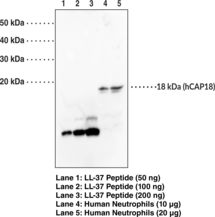
LL-37 is a cationic α-helical peptide expressed in human bone marrow, testis, granulocytes, gingival epithelium, and a variety of immune cells.1 It is produced by proteolytic cleavage of the cathelicidin human cationic antimicrobial protein of 18 kDa (hCAP18).2 LL-37 has antimicrobial and antiviral activity, and protein levels of LL-37 are increased in epithelial cells, macrophages, and neutrophils following bacterial infection in vitro.1,3,4,5 It functions as a chemoattractant for human monocytes, neutrophils, and T cells, and induces chemokine secretion from epithelial cells in infected tissues.6,2 LL-37 is a component of LPS-induced NETs produced from human neutrophils isolated from patients with systemic lupus erythrematosus (SLE) or individuals without SLE.7 It also enhances PMA- or S. aureus-induced formation of NETs.8 LL-37 can be citrullinated by protein arginine deiminase 2 (PAD2) and PAD4, a modification that reduces its antibacterial and antiviral activities.9,5 Native, but not citrullinated, LL-37 prevents mortality in a mouse model of D-galactosamine-sensitized endotoxic shock.9 Cayman's LL-37 Polyclonal Antibody can be used for Western blot.
WARNING This product is not for human or veterinary use.
References & Product Citations
1. Epithelial antimicrobial peptides: Review and significance for oral applications. Crit. Rev. Oral Biol. Med. 9(4), 399-414 (1998).
2. The human cathelicidin hCAP18/LL-
3. Expression of cathelicidin LL-
4. The human gene FALL39 and processing of the cathelin precursor to the antibacterial peptide LL-
5. Citrullination alters the antiviral and immunomodulatory activities of the human cathelicidin LL-
6. LL-
7. Neutrophil extracellular trap-
8. Blasticidin S-
9. Citrullination alters immunomodulatory function of LL-
Contact Info
Cayman Chemical1180 East Ellsworth RoadAnn Arbor, Michigan 48108 USAToll Free: (800) 364-9897(USA and Canada only)Fax: (734) 971-3640


