
For immunochemical detection of L-PGDS
Technical Support & Resources

Visit our FAQ

Contact Us

Toll Free Phone (USA and Canada Only): (888) 526-5351
Direct Phone: (734) 975-3888

Request Technical Support

Technical Support Request

To streamline the process attach the appropriate questionnaire to your inquiry.

Download IHC QuestionnaireDownload WB Questionnaire

View Our Privacy Statement for details on how we use and protect your data. In addition, this site is protected by hCaptcha and its Privacy Policy and Terms of Service apply.

Prostaglandin D Synthase (lipocalin-type) Polyclonal Antibody

Item No. 160003
Technical Information
Synonyms
  • L-PGDS
  • Lipocalin-PGDS
Immunogen
Synthetic peptide from the internal region of human lipocalin-type PGDS
Peptide affinity-purified polyclonal antibody
Storage Buffer
TBS, pH 7.4, when reconstituted in 500 µl deionized water
Host
Rabbit
Applications
WB
Cross Reactivity
(-) H-PGDS
Species Reactivity
(+) Human(+) Mouse
UniProt Accession №
P41222
Origin
Animal/Rabbit
Shipping & Storage Information
Storage
-20°C
Shipping
Wet ice in continental US; may vary elsewhere
Recommended Products

Certificates of Analysis & Batch Specific Data

Provide batch numbers separated by commas to download or request available product inserts, QC sheets, certificates of analysis, data packs, and GC-MS data.

    Add

    Lipid Resource Center
    Discover Products & Resources for Lipid Research
    • High-purity lipid standards
    • Lipid roles in biology
    • Lipids in health & disease
    • Lipids for pharmaceutical development
    • Protocols, advice, & resources
    EXPLORE NOW
    Product Description

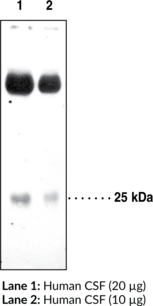
    Prostaglandin D synthase (PGDS) catalyzes the isomerization of PGH2 to produce PGD2. PGD2 induces sleep, regulates nociception, inhibits platelet aggregation, and acts as an allergic mediator. Two distinct types of PGDS have been identified, namely the lipocalin-type enzyme (β-trace) and the hematopoietic enzyme.1,2 Lipocalin-type PGDS is localized in the central nervous system and male genital organs of various mammals and the human heart whereas the hematopoietic PGDS is widely distributed in the peripheral tissues and localized in the antigen-presenting cells, mast cells, and megakaryocytes.1,3,4,5 The lipocalin-type PGDS has been identified as β-trace, which is a major protein in human cerebrospinal fluid.2,6 Human lipocalin-type PGD synthase is a 190 amino acid protein with a calculated molecular weight of 21,016.7

    WARNING This product is not for human or veterinary use.

    References & Product Citations
    Product Description References

    1. Urade, Y., Watanabe, K., and Hayaishi, O. Prostaglandin D, E, and F synthases. J. Lipid Mediat. Cell Signal. 12(2-3), 257-273 (1995).

    2. Toh, H., Kubodera, H., Nakajima, N., et alGlutathione-independent prostaglandin D synthase as a lead molecule for designing new functional proteins. Protein Eng. 9(12), 1067-1082 (1996).

    3. Tokugawa, Y., Kunishige, I., Kuboto, Y., et alLipocalin-type prostaglandin D synthase in human male reproductive organs and seminal plasma. Biol. Reprod. 58(2), 600-607 (1998).

    4. Melegos, D.N., Diamandis, E.P., Oda, H., et alImmunofluorometric assay of prostaglandin D synthase in human tissue extracts and fluids. Clin. Chem. 42(12), 1984-1991 (1996).

    5. Kanaoka, Y., Fujimori, K., Kikuno, R., et alStructure and chromosomal localization of human and mouse genes for hematopoietic prostaglandin D synthase. Eur. J. Biochem. 267(11), 3315-3322 (2000).

    6. Zahn, M., Mäder, A., Schmidt, B., et alPurification and N-terminal sequence of β-trace, a protein abundant in human cerebrospinal fluid. Neurosci. Lett. 154(1-2), 93-95 (1993).

    7. Nagata, A., Suzuki, Y., Igarashi, M., et alHuman brain prostaglandin D synthase has been evolutionarily differentiated from lipophilic-ligand carrier proteins. Proc. Natl. Acad. Sci. USA 88, 4020-4024 (1991).

