
Technical Support & Resources
Information provided in the product description is from published literature. Due to the nature of scientific experimentation, your results (e.g., selectivity and effective concentrations) or specific application for this product may differ. If you have questions about how this product fits your application, please contact our technical support staff.
Visit our FAQ
Contact Us
Toll Free Phone (USA and Canada Only): (888) 526-5351
Direct Phone: (734) 975-3888
Product Categories
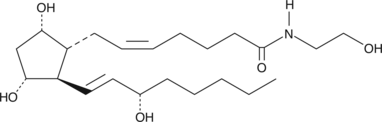
Technical Information
- Dinoprost Ethanolamide
- PGF2α-EA
Shipping & Storage Information
Recommended Products
Certificates of Analysis & Batch Specific Data
Provide batch numbers separated by commas to download or request available product inserts, QC sheets, certificates of analysis, data packs, and GC-MS data.
Lipid Resource Center
Discover Products & Resources for Lipid Research
- High-purity lipid standards
- Lipid roles in biology
- Lipids in health & disease
- Lipids for pharmaceutical development
- Protocols, advice, & resources
Product Description
Prostaglandin F2α ethanolamide (PGF2α-EA) is produced by COX-2 metabolism of the endogenous cannabinoid, arachidonoyl ethanolamide (AEA), found in brain, liver, and other mammalian tissues.1 AEA can be metabolized directly by the sequential action of COX-2 and specific PG synthases to produce ethanolamide congeners of the classical PGs.2,3 PGF2α-EA has also been reported to be biosynthesized by this mechanism when AEA was infused into the lung and liver of living mice. PGF2α-EA is a potent dilator (EC50 = 58 nM) of the cat iris sphincter, which is a model system for testing potential intraocular hypotensive agents.4
WARNING This product is not for human or veterinary use.
References & Product Citations
1. Fatty acid amides of ethanolamine in mammalian tissues. The Journal of Biological Chemisty 240, 1019-1024 (1965).
2. Synthesis of prostaglandin E2 ethanolamide from anandamide by cyclooxygenase-
3. Metabolism of the endocannabinoids, 2-
4. Prostaglandin F2α (PGF2α) 1-
Structural determinants for calcium mobilization by prostaglandin E2 and prostaglandin F2α glyceryl esters in RAW 264.7 cells and H1819 cells. Prostaglandins Other Lipid Mediat. 92(1-4), 19-24 (2010).
Contact Info
Cayman Chemical1180 East Ellsworth RoadAnn Arbor, Michigan 48108 USAToll Free: (800) 364-9897(USA and Canada only)Fax: (734) 971-3640


