
For immunochemical detection of cPGES
Technical Support & Resources

Visit our FAQ

Contact Us

Toll Free Phone (USA and Canada Only): (888) 526-5351
Direct Phone: (734) 975-3888

Request Technical Support

Technical Support Request

To streamline the process attach the appropriate questionnaire to your inquiry.

Download IHC QuestionnaireDownload WB Questionnaire

View Our Privacy Statement for details on how we use and protect your data. In addition, this site is protected by hCaptcha and its Privacy Policy and Terms of Service apply.

Prostaglandin E Synthase (cytosolic) Polyclonal Antibody

Item No. 160150
Technical Information
Synonyms
  • p23
  • cPGE Synthase
  • cPGES
  • Hsp90 Co-chaperone
  • Teolomerate-binding protein p23
Immunogen
Synthetic peptide from an internal region of human protein cPGES synthase
500 µl of peptide affinity-purified polyclonal antibody
Storage Buffer
PBS, pH 7.2, with 50% glycerol, and 0.02% sodium azide
Host
Rabbit
Applications
WB
Cross Reactivity
(-) mPGES
Species Reactivity
(+) Human(+) Mouse(+) Ovine
UniProt Accession №
Q15185
Origin
Animal/Rabbit
Shipping & Storage Information
Storage
-20°C
Shipping
Wet ice in continental US; may vary elsewhere
Recommended Products

Certificates of Analysis & Batch Specific Data

Provide batch numbers separated by commas to download or request available product inserts, QC sheets, certificates of analysis, data packs, and GC-MS data.

    Add

    Lipid Resource Center
    Discover Products & Resources for Lipid Research
    • High-purity lipid standards
    • Lipid roles in biology
    • Lipids in health & disease
    • Lipids for pharmaceutical development
    • Protocols, advice, & resources
    EXPLORE NOW
    Product Description

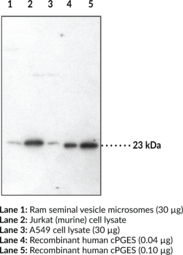
    Prostaglandin E synthase (PGES) catalyzes the isomerization of PGH2 (Item No. 17020) to PGE2 (Item No. 14010). Cytosolic and microsomal PGES enzymes have been cloned and characterized. Cytosolic PGES (cPGES) is a glutathione-dependent enzyme with a predicted size of 18.6 kDa (23 kDa on SDS-PAGE). The enzyme is expressed in a wide variety of tissues and cells, the levels of which are unaffected by treatment with IL-1β and TNF-α.1 However, enzyme expression increases approximately 3-fold in rat brain following LPS treatment.1 Microsomal PGES (mPGES) is a 16 kDa protein expressed in a variety of tissues including prostate, testes, and small intestine, as well as in A549 and HeLa cells.2 In contrast to cPGES, mPGES protein expression is increased in A549 cells following treatment with IL-1β.2 The two enzymes show <10% homology at the amino acid level.

    WARNING This product is not for human or veterinary use.

    References & Product Citations
    Product Description References

    1. Tanioka, T., Nakatani, Y., Semmyo, N., et alMolecular identification of cytosolic prostaglandin E2 synthase that is functionally coupled with cyclooxygenase-1 immediate prostaglandin E2 biosynthesis. The Journal of Biological Chemisty 275, 32775-32782 (2000).

    2. Jakobsson, P.J., Thorén, S., Morgenstern, R., et alIdentification of human prostaglandin E synthase: A microsomal, glutathione-dependent, inducible enzyme, constituting a potential novel drug target. Proc. Natl. Acad. Sci. USA 96(13), 7220-7225 (1999).

    Product Citations

    Sun, Y., Jia, Z., Liu, G., et alPPARγ agonist rosiglitazone suppresses renal mPGES-1/PGE2 pathway in db/db mice. PPAR Res. 2013:e612971, (2013).

    Wobst, I., Schiffmann, S., Birod, K., et alDimethylcelecoxib inhibits prostaglandin E2 production. Biochem. Pharmacol. 76(1), 62-69 (2008).

