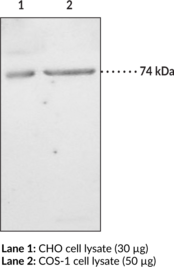
For immunochemical detection of iPLA2
Technical Support & Resources

Visit our FAQ

Contact Us

Toll Free Phone (USA and Canada Only): (888) 526-5351
Direct Phone: (734) 975-3888

Request Technical Support

Technical Support Request

To streamline the process attach the appropriate questionnaire to your inquiry.

Download IHC QuestionnaireDownload WB Questionnaire

View Our Privacy Statement for details on how we use and protect your data. In addition, this site is protected by hCaptcha and its Privacy Policy and Terms of Service apply.

iPLA2 (Type VI) Polyclonal Antibody

Item No. 160507

Technical Information
Synonyms
  • Calcium-independent Phospholipase A2
Immunogen
Synthetic peptide from an internal region of human iPLA2 (Type VI)
500 ul peptide affinity-purified polyclonal antibody
Storage Buffer
PBS, pH 7.2, with 50% glycerol and 0.02% sodium azide
Host
Rabbit
Isotype
IgG
Applications
WB; other applications not tested
Cross Reactivity
(-) cPLA2(-) sPLA2
Species Reactivity
(+) Human iPLA2(+) Hamster iPLA2(+) Mouse iPLA2(+) Rat iPLA2
UniProt Accession №
O60733
Origin
Animal/Rabbit
Shipping & Storage Information
Storage
-20°C
Shipping
Wet ice in continental US; may vary elsewhere
Recommended Products

Certificates of Analysis & Batch Specific Data

Provide batch numbers separated by commas to download or request available product inserts, QC sheets, certificates of analysis, data packs, and GC-MS data.

    Add

    Lipid Resource Center
    Discover Products & Resources for Lipid Research
    • High-purity lipid standards
    • Lipid roles in biology
    • Lipids in health & disease
    • Lipids for pharmaceutical development
    • Protocols, advice, & resources
    EXPLORE NOW
    Product Description

    Calcium-independent phospholipase A2 (iPLA2) is one of the most recently characterized isoforms in the growing list of the phospholipase A2 enzyme family.1 iPLA2 has been purified or cloned from CHO cells and mouse P388D1 macrophage-like cells and is the major isoform of phospholipase A2 found in A-10 smooth muscle cells.2,3,4,5,6,7 The enzyme has a molecular weight of about 80-85 kDa and is classified as a type VI PLA2.1-5 The enzyme from CHO cells is approximately 95% and 90% homologous to mouse and human iPLA2, respectively.2,3

    WARNING This product is not for human or veterinary use.

    References & Product Citations
    Product Description References

    1. Dennis, E.A. The growing phospholipase A2 superfamily of signal transduction enzymes. Trends Biochem. Sci. 22(1), 1-2 (1997).

    2. Tang, J., Kriz, R.W., Wolfman, N., et alA novel cytosolic calcium-independent phospholipase A2 contains eight ankyrin motifs. The Journal of Biological Chemisty 272(13), 8567-8575 (1997).

    3. Balboa, M.A., Balsinde, J., Jones, S.S., et alIdentity between the Ca2+-independent phospholipase A2 enzymes from P388D1 macrophages and Chinese hamster ovary cells. The Journal of Biological Chemisty 272(13), 8576-8580 (1997).

    4. Wolf, M.J., and Gross, R.W. Expression, purification, and kinetic characterization of a recombinant 80-kDa intracellular calcium-independent phospholipase A2. The Journal of Biological Chemisty 271(48), 30879-30885 (1996).

    5. Ackermann, E.J., Kempner, E.S., and Dennis, E.A. Ca2+-independent cytosolic phospholipase A2 from macrophage-like P388D1 cells. The Journal of Biological Chemisty 269(12), 9227-9233 (1994).

    6. Wolf, M.J., Wang, J., Turk, J., et alDepletion of intracellular calcium stores activates smooth muscle cell calcium-independent phospholipase A2. The Journal of Biological Chemisty 272(3), 1522-1526 (1997).

    7. Wolf, M.J., and Gross, R.W. The calcium-dependent association and functional coupling of calmodulin with myocardial phospholipase A2. Implications for cardiac cycle-dependent alterations in phospholipolysis. The Journal of Biological Chemisty 271(35), 20989-20992 (1996).

    Product Citations

    Aoto, M., Shinzawa, K., Suzuki, Y., et alEssential role of p38 MAPK in caspase-independent, iPLA(2)-dependent cell death under hypoxia/low glucose conditions. FEBS Lett. 583(10), 1611-1618 (2009).