
For immunochemical detection of the PAF receptor
Technical Support & Resources

Visit our FAQ

Contact Us

Toll Free Phone (USA and Canada Only): (888) 526-5351
Direct Phone: (734) 975-3888

Request Technical Support

Technical Support Request

To streamline the process attach the appropriate questionnaire to your inquiry.

Download IHC QuestionnaireDownload WB Questionnaire

View Our Privacy Statement for details on how we use and protect your data. In addition, this site is protected by hCaptcha and its Privacy Policy and Terms of Service apply.

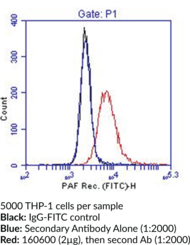
PAF Receptor (human) Monoclonal Antibody (11A4, Clone 21)

Item No. 160600
Technical Information
Synonyms
  • Platelet-activating Factor Receptor
Immunogen
Synthetic peptide from the internal region of human PAF receptor
Clone Designation
11A4, Clone 21
100 µg of protein A-purified monoclonal antibody
Storage Buffer
TBS, pH 7.4, when reconstituted in 500 µl of deionized water
Host
Mouse
Isotype
IgG2a
Applications
(+) ELISA, FC, and ICC; (−) WB
Species Reactivity
(+) Human PAF receptor(+) Bovine PAF receptor(+) Porcine PAF receptor
UniProt Accession №
P25105
Origin
Animal/Mouse
Shipping & Storage Information
Storage
-20°C
Shipping
Wet ice in continental US; may vary elsewhere
Recommended Products

Certificates of Analysis & Batch Specific Data

Provide batch numbers separated by commas to download or request available product inserts, QC sheets, certificates of analysis, data packs, and GC-MS data.

    Add

    Lipid Resource Center
    Discover Products & Resources for Lipid Research
    • High-purity lipid standards
    • Lipid roles in biology
    • Lipids in health & disease
    • Lipids for pharmaceutical development
    • Protocols, advice, & resources
    EXPLORE NOW
    Product Description

    PAF is a potent phospholipid mediator which exerts diverse biological actions by interaction with a G protein-coupled PAF receptor. The PAF receptor has been cloned from a number of species including human, rat, and guinea pig and is characterized as a 7-transmembrane receptor which induces phosphoinositol turnover through G-protein coupling.1,2,3,4,5 Northern blot analysis reveals that the receptor is expressed in leukocytes, placenta, lung, spleen, small intestine, kidney, liver, and brain.3,4 In leukocyte cell populations the receptor is found on platelets, monocytes, neutrophils, and B-cells, whereas resting T-cells and natural killer cell lines do not express the PAF receptor.6 Human monocytes treated with INF-γ have a 2-6 fold increase in PAF receptor expression compared to untreated cells.7

    WARNING This product is not for human or veterinary use.

    References & Product Citations
    Product Description References

    1. Nakamura, M., Honda, Z.i., Izumi, T., et alMolecular cloning and expression of platelet-activating factor receptor from human leukocytes. The Journal of Biological Chemisty 266(30), 20400-20405 (1991).

    2. Kunz, D., Gerard, N.P., and Gerard, C. The human leukocyte platelet-activating factor receptor. cDNA cloning, cell surface expression, and construction of a novel epitope-bearing analog. The Journal of Biological Chemisty 267, 9101-9106 (1992).

    3. Ye, R.D., Prossnitz, E.R., Zou, A., et alCharacterization of a human cDNA that encodes a functional receptor for platelet activating factor. Biochem. Biophys. Res. Commun. 180, 105-111 (1991).

    4. Bito, H., Honda, Z.i., Nakamura, M., et alCloning, expression and tissue distribution of rat platelet-activating-factor-receptor cDNA. Eur. J. Biochem. 227, 211-218 (1994).

    5. Honda, Z.i., Nakamura, M., Miki, I., et alCloning by functional expression of platelet-activating factor receptor from guinea-pig lung. Nature 349, 342-346 (1991).

    6. Müller, E., Dagenais, P., Alami, N., et alIdentification and functional characterization of platelet-activating factor receptors in human leukocyte populations using polyclonal anti-peptide antibody. Proc. Natl. Acad. Sci. USA 90, 5818-5822 (1993).

    7. Quellet, S., Müller, E., and Rola-Pleszczynski, M. IFN-γ up-regulates platelet-activating factor receptor gene expression in human monocytes. J. Immunol. 152, 5092-5099 (1994).

