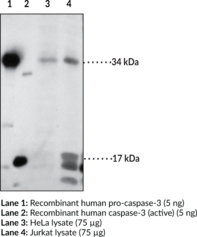
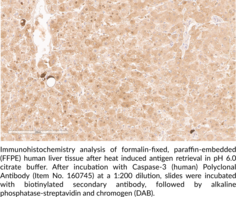
For immunochemical detection of Caspase-3
Technical Support & Resources

Visit our FAQ

Contact Us

Toll Free Phone (USA and Canada Only): (888) 526-5351
Direct Phone: (734) 975-3888

Request Technical Support

Technical Support Request

To streamline the process attach the appropriate questionnaire to your inquiry.

Download IHC QuestionnaireDownload WB Questionnaire

View Our Privacy Statement for details on how we use and protect your data. In addition, this site is protected by hCaptcha and its Privacy Policy and Terms of Service apply.

Caspase-3 (human) Polyclonal Antibody

Item No. 160745

Technical Information
Synonyms
  • Apopain
  • CASP3
  • Cysteine Protease CPP32
  • Protein Yama
  • SCA-1
  • SREBP Cleavage Activity 1
Immunogen
Synthetic peptide from an internal region of human caspase-3
500 µl Peptide affinity-purified polyclonal antibody
Storage Buffer
TBS, pH 7.4, when reconstituted with 500 µl double distilled water
Host
Rabbit
Applications
WB and IHC
Cross Reactivity
(+) proform and active subunits of caspase-2
Species Reactivity
(+) Human Caspase-3(+) Baboon Caspase-3(+) Hamster Caspase-3(+) Mouse Caspase-3
UniProt Accession №
P42574
Origin
Animal/Rabbit
Shipping & Storage Information
Storage
-20°C
Shipping
Wet ice in continental US; may vary elsewhere
Recommended Products

Certificates of Analysis & Batch Specific Data

Provide batch numbers separated by commas to download or request available product inserts, QC sheets, certificates of analysis, data packs, and GC-MS data.

    Add

    Product Description

    Apoptosis is associated with many diseases and is induced by a family of cell death receptors and their ligands. Cell death signals are transduced by death domain containing adapter molecules and members of the caspase family of proteases. Caspase-3 is a key effector caspase in the apoptosis cascade.1,2 The enzyme is efficiently activated by caspase-8, caspase-9, and granzyme B resulting in 17 and 12 kDa active subunits formed from the 34 kDa proenzyme.1,3 The substrates of caspase-3 are numerous and include pro- and anti-apoptotic proteins, downstream components of the apoptotic machinery (for example, ICAD), as well as structural and homeostatic proteins.1,2 DNA fragmentation and the morphological changes associated with this final stage of apoptosis appears to be dependent upon caspase-3.4 Caspase-3 is expressed in a variety of tissues and cells.5,6

    WARNING This product is not for human or veterinary use.

    References & Product Citations
    Product Description References

    1. Wolf, B.B., and Green, D.R. Suicidal tendencies: Apoptotic cell death by caspase family proteinases. The Journal of Biological Chemisty 274(29), 20049-20052 (1999).

    2. Villa, P., Kaufman, S.H., and Earnshaw, W.C. Caspases and caspase inhibitors. Trends Biochem. Sci. 22(10), 388-393 (1997).

    3. Jänicke, R.U., Sprengart, M.L., Wati, M.R., et alCaspase-3 is required for DNA fragmentation and morphological changes associated with apoptosis. The Journal of Biological Chemisty 273(16), 9357-9360 (1998).

    4. Fernandes-Alnemri, T., Litwack, G., and Alnemri, E.S. CPP32, a novel human apoptotic protein with homology to Caenorhabditis elegans cell death protein Ced-3 and mammalian interleukin-1β-converting enzyme. The Journal of Biological Chemisty 269(49), 30761-30764 (1994).

    5. Juan, T.S.C., McNiece, I.K., Jenkins, N.A., et alMolecular characterization of mouse and rat CPP32β gene encoding a cysteine protease resembling interleukin-1β converting enzyme and CED-3. Oncogene 13(4), 749-755 (1996).