
Technical Support & Resources
Visit our FAQ
Contact Us
Toll Free Phone (USA and Canada Only): (888) 526-5351
Direct Phone: (734) 975-3888
Product Categories
Technical Information
- sGC β1 subunit
- GCS-beta-1
- Gucy1b1
Shipping & Storage Information
Recommended Products
Certificates of Analysis & Batch Specific Data
Provide batch numbers separated by commas to download or request available product inserts, QC sheets, certificates of analysis, data packs, and GC-MS data.
Product Description
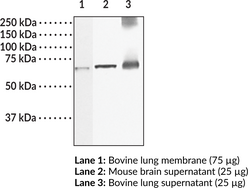
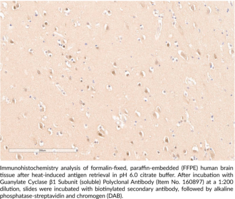
Soluble guanylate cyclase (sGC) is a heterodimeric hemoprotein and nitric oxide (NO) sensor composed of two subunits, α1 and β1.1,2 The approximately 70 kDa sGC β1 subunit is encoded by GUCY1B3 in humans, ubiquitously expressed, and localized to the cytosol.3 The sGC histidine residue at position 105 is ligated to a ferrous heme that selectively binds NO to activate the C-terminal guanylate cyclase activity of the sGC heterodimer, catalyzing the synthesis of cGMP.1,4 Knockdown of Gucy1B3 or expression of a heme-deficient sGC β1 subunit inhibits NO-induced reductions in blood pressure and platelet activation in mice, indicating a heme-dependent role for the sGC β1 subunit in blood pressure regulation.5 Cayman’s Guanylate Cyclase β1 subunit (soluble) Polyclonal Antibody can be used for immunohistochemistry (IHC) and Western blot (WB) applications. The antibody recognizes the sGC β1 subunit from human, bovine, and rat samples.
WARNING This product is not for human or veterinary use.
References & Product Citations
1. Characterization of functional heme domains from soluble guanylate cyclase. Biochemistry 44(49), 16266-16274 (2005).
2. Structure and activation of soluble guanylyl cyclase, the nitric oxide sensor. Antioxid. Redox Signal. 26(3), 107-121 (2017).
3. Structure and regulation of soluble guanylate cyclase. Annu. Rev. Biochem. 81, 533-559 (2012).
4. Molecular variants of soluble guanylyl cyclase affecting cardiovascular risk. Circ. J. 79(3), 463-469 (2015).
5. Cardiovascular and pharmacological implications of haem-
Inhibition of MPO (myeloperoxidase) attenuates endothelial dysfunction in mouse models of vascular inflammation and atherosclerosis. Arterioscler. Thromb. Vasc. Biol. 39(7), 1448-1457 (2019).
Nucleotidyl cyclase activity of soluble guanylyl cyclase in intact cells. Biochem. Biophys. Res. Commun. 443(4), 1195-1199 (2014).
Contact Info
Cayman Chemical1180 East Ellsworth RoadAnn Arbor, Michigan 48108 USAToll Free: (800) 364-9897(USA and Canada only)Fax: (734) 971-3640


