
Technical Support & Resources
Information provided in the product description is from published literature. Due to the nature of scientific experimentation, your results (e.g., selectivity and effective concentrations) or specific application for this product may differ. If you have questions about how this product fits your application, please contact our technical support staff.
Visit our FAQ
Contact Us
Toll Free Phone (USA and Canada Only): (888) 526-5351
Direct Phone: (734) 975-3888
Product Categories

Technical Information
- DFMA
- RMI 71897
Shipping & Storage Information
Recommended Products
Certificates of Analysis & Batch Specific Data
Provide batch numbers separated by commas to download or request available product inserts, QC sheets, certificates of analysis, data packs, and GC-MS data.
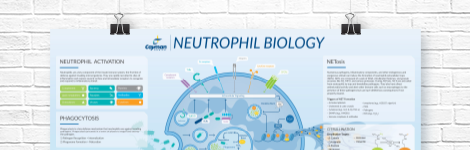
Neutrophil Biology Wall Poster
Explore how neutrophils shape the immune response in health and disease. This poster highlights neutrophil pathogen defense mechanisms, including phagocytosis, degranulation, and NETosis, as well as neutrophil roles in inflammation and NET-associated pathologies.
DOWNLOAD NOWProduct Description
Bacteria synthesize the cellular growth factor putrescine through a number of pathways. One pathway involves the decarboxylation of arginine by arginine decarboxylase to produce agmatine, which is then degraded to putrescine. While important for various cellular processes (e.g., cell division, differentiation, environmental stress responses) in all living organisms, including plants, high levels of this polyamine can be toxic.1 α-(difluoromethyl)-DL-Arginine (DFMA) is an enzyme-activated, irreversible inhibitor of the arginine decarboxylases of E. coli (Ki = 800 µM), P. aeruginosa, and K. pneumoniae.2 At 0.01 mM, it has been shown to prevent the osmotic stress-induced increase in arginine decarboxylase activity and putrescine synthesis in oat leaf cells.3,4 DFMA can also reduce the growth of T. cruzi in mammalian host cells at a minimal concentration of 10 mM and prevent the growth of C. parvum in a T cell receptor alpha-deficient mouse model when combined with various polyamine analogs.5,6
WARNING This product is not for human or veterinary use.
References & Product Citations
1. Polyamines and abiotic stress tolerance in plants. Plant Signal. Behav. 5(1), 26-33 (2010).
2. DL-
3. Polyamine metabolism and osmotic stress. II. Improvement of oat protoplasts by an inhibitor of arginine decarboxylase. Plant Physiol. 82(2), 375-378 (1986).
4. Polyamines and plant stress: Activation of putrescine biosynthesis by osmotic shock. Science 217(4566), 1259-1261 (1982).
5. Arginine decarboxylase inhibitors reduce the capacity of Trypanosoma cruzi to infect and multiply in mammalian host cells. Proc. Natl. Acad. Sci. USA 84(12), 4278-4282 (1987).
6. Activities of DL-
Contact Info
Cayman Chemical1180 East Ellsworth RoadAnn Arbor, Michigan 48108 USAToll Free: (800) 364-9897(USA and Canada only)Fax: (734) 971-3640


