
Technical Support & Resources
Information provided in the product description is from published literature. Due to the nature of scientific experimentation, your results (e.g., selectivity and effective concentrations) or specific application for this product may differ. If you have questions about how this product fits your application, please contact our technical support staff.
Visit our FAQ
Contact Us
Toll Free Phone (USA and Canada Only): (888) 526-5351
Direct Phone: (734) 975-3888
Product Categories

Technical Information
Shipping & Storage Information
Recommended Products
Certificates of Analysis & Batch Specific Data
Provide batch numbers separated by commas to download or request available product inserts, QC sheets, certificates of analysis, data packs, and GC-MS data.
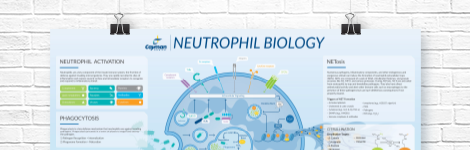
Neutrophil Biology Wall Poster
Explore how neutrophils shape the immune response in health and disease. This poster highlights neutrophil pathogen defense mechanisms, including phagocytosis, degranulation, and NETosis, as well as neutrophil roles in inflammation and NET-associated pathologies.
DOWNLOAD NOWProduct Description
Tomatidine is a steroidal alkaloid that has been found in the skins and leaves of tomatoes.1 It suppresses NF-κB signaling in LPS-stimulated macrophages, blocking induced expression of inducible nitric oxide synthase (iNOS) and COX-2. Tomatidine inhibits acid sphingomyelinase activity by 84.2% when used at a concentration of 10 mM.2 It also has antibacterial properties, preferentially blocking the replication of S. aureus variants that are pathogenic in cystic fibrosis over normal strains (MICs = 0.12 and >16 µg/ml, respectively).3 It prevents skeletal muscle atrophy associated with fasting or spinal cord injury in mice.4 Tomatidine has also been used as a negative control for cyclopamine (Item No. 11321) in studies involving signaling mediated by the hedgehog pathway.5
WARNING This product is not for human or veterinary use.
References & Product Citations
1. Tomatidine inhibits iNOS and COX-
2. Identification of novel functional inhibitors of acid sphingomyelinase. PLoS One 6(8), e23852 (2011).
3. Tomatidine inhibits replication of Staphylococcus aureus small-
4. Systems-
5. Hedgehog signalling is essential for maintenance of cancer stem cells in myeloid leukaemia. Nature 458(7239), 776-779 (2009).
Contact Info
Cayman Chemical1180 East Ellsworth RoadAnn Arbor, Michigan 48108 USAToll Free: (800) 364-9897(USA and Canada only)Fax: (734) 971-3640


