
Technical Support & Resources
Information provided in the product description is from published literature. Due to the nature of scientific experimentation, your results (e.g., selectivity and effective concentrations) or specific application for this product may differ. If you have questions about how this product fits your application, please contact our technical support staff.
Visit our FAQ
Contact Us
Toll Free Phone (USA and Canada Only): (888) 526-5351
Direct Phone: (734) 975-3888
Technical Information
- PGH1
- PGR1
- Prostaglandin R1
Shipping & Storage Information
Recommended Products
Certificates of Analysis & Batch Specific Data
Provide batch numbers separated by commas to download or request available product inserts, QC sheets, certificates of analysis, data packs, and GC-MS data.
Lipid Resource Center
Discover Products & Resources for Lipid Research
- High-purity lipid standards
- Lipid roles in biology
- Lipids in health & disease
- Lipids for pharmaceutical development
- Protocols, advice, & resources
Product Description
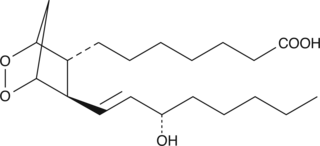
Prostaglandin H1 (PGH1) is the unstable precursor to all 1-series PGs and thromboxanes.1,2,3 It is produced from dihomo-γ-linolenic acid (DGLA; Item No. 90230) by COX-1 and COX-2. 4,2 PGH1 is an agonist of the PGD2 receptor CRTH2.5 It increases intracellular calcium levels in HEK293 cells expressing CRTH2 when used at a concentration of 3 µM and induces CRTH2 internalization at 1 µM, an effect that can be blocked by the CRTH2 antagonist TM30089 (CAY10471; Item No. 10006735). PGH1 is also a suicide inhibitor of platelet thromboxane synthase (Ki = 28 µM).6
WARNING This product is not for human or veterinary use.
References & Product Citations
1. Isolation and properties of intermediates in prostaglandin biosynthesis. Biochim. Biophys. Acta 326(3), 448-461 (1973).
2. Prostaglandins and related compounds. Inflammation 374-422 (1978).
3. Unorthodox routes to prostanoid formation: New twists in cyclooxygenase-
4. Prostaglandin synthetase system – Resolution into oxygenase and isomerase components. Proc. Natl. Acad. Sci. USA 71(9), 3645-3648 (1974).
5. PGH1, the precursor for the anti-
6. "Suicide" inactivation of thromboxane A2 synthase. Characteristics of mechanism-
PGH1, the precursor for the anti-
Contact Info
Cayman Chemical1180 East Ellsworth RoadAnn Arbor, Michigan 48108 USAToll Free: (800) 364-9897(USA and Canada only)Fax: (734) 971-3640


