
Technical Support & Resources
Information provided in the product description is from published literature. Due to the nature of scientific experimentation, your results (e.g., selectivity and effective concentrations) or specific application for this product may differ. If you have questions about how this product fits your application, please contact our technical support staff.
Visit our FAQ
Contact Us
Toll Free Phone (USA and Canada Only): (888) 526-5351
Direct Phone: (734) 975-3888
Product Categories
Product Type

Technical Information
- Polymyxin E Complex
Shipping & Storage Information
Recommended Products
Certificates of Analysis & Batch Specific Data
Provide batch numbers separated by commas to download or request available product inserts, QC sheets, certificates of analysis, data packs, and GC-MS data.
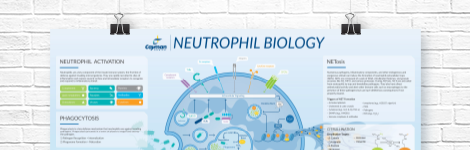
Neutrophil Biology Wall Poster
Explore how neutrophils shape the immune response in health and disease. This poster highlights neutrophil pathogen defense mechanisms, including phagocytosis, degranulation, and NETosis, as well as neutrophil roles in inflammation and NET-associated pathologies.
DOWNLOAD NOWProduct Description
Colistin is a complex antibiotic containing greater than 30 components, with the cyclic polypeptide antibiotics polymyxins E1 (colistin A) and E2 (colistin B) as the major components.1,2 It was originally isolated from B. polymyxa.1 Colistin inhibits the growth of the Gram-negative bacteria E. coli, P. aeruginosa, P. fluorescens, and S. enterica (MICs = 0.04-2.08 μg/ml) and Gram-positive L. ivanovii and L. monocytogenes (MICs = 2.5-10 μg/ml) but is not active against Gram-positive L. lactis, P. polymyxa, P. acidilactici, or S. aureus at concentrations up to 5 μg/ml.3 It also inhibits the growth of clinical isolates of both susceptible and multidrug-resistant P. aeruginosa (MICs = 1-2 mg/l).4 Colistin binds selectively to LPS from susceptible strains of K. pneumoniae compared to resistant strains (Kis = 0.56 and 2.83 μM, respectively), which may contribute to its mechanism of action against Gram-negative bacteria.5 In vivo, colistin slows the growth of P. aeruginosa and A. baumannii in a neutropenic mouse model of thigh infection.6
WARNING This product is not for human or veterinary use.
References & Product Citations
1. Studies on the chemical structure of colistin. I. Fractionation, molecular weight determination, amino acid and fatty acid composition. J. Biochem. 54(1), 25-33 (1963).
2. Validation of a novel LC-
3. Colistin A and colistin B among inhibitory substances of Paenibacillus polymyxa JB05-
4. In vitro activity of polymyxins in combination with β-
5. Surface changes and polymyxin interactions with a resistant strain of Klebsiella pneumoniae. Innate Immun. 20(4), 350-363 (2014).
6. New pharmacokinetic/pharmacodynamic studies of systemically administered colistin against Pseudomonas aeruginosa and Acinetobacter baumannii in mouse thigh and lung infection models: Smaller response in lung infection. J. Antimicrob. Chemother. 70(12), 3291-3297 (2015).
Contact Info
Cayman Chemical1180 East Ellsworth RoadAnn Arbor, Michigan 48108 USAToll Free: (800) 364-9897(USA and Canada only)Fax: (734) 971-3640


