
Technical Support & Resources
Visit our FAQ
Contact Us
Toll Free Phone (USA and Canada Only): (888) 526-5351
Direct Phone: (734) 975-3888
Product Categories
Application
Histone H1.4 (Citrullinated R53) Polyclonal Antibody
Item No. 18073
Technical Information
Shipping & Storage Information
Recommended Products
Certificates of Analysis & Batch Specific Data
Provide batch numbers separated by commas to download or request available product inserts, QC sheets, certificates of analysis, data packs, and GC-MS data.

Visit Our Cancer Resource Center
Find Tools & Resources to Study the Hallmarks of Cancer
- Cancer cell signaling & regulation
- Cancer metabolism
- Tumor microenvironment
Product Description
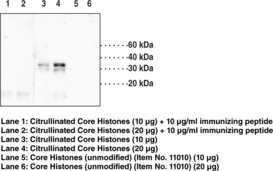
Citrullinated histone H1.4 is a citrullinated form of histone H1.4, a nuclear protein that interacts with linker DNA regions between nucleosomes to provide nucleosome core structure stabilization.1 Histone H1 subtypes are comprised of a short N-terminal domain, a central globular domain necessary for DNA interaction, and long C-terminal domain that determines subtype binding properties by its variability. Histone H1.4 is expressed in most somatic cell types and is essential for survival of T47D and MCF-7 breast cancer cells and MCF-10A breast epithelial cells.2,3,4 It is subject to citrullination by protein-arginine deiminase 4 (PAD4) at arginine 54, which corresponds to arginine 53 of the immunizing peptide for Cayman’s Histone H1.4 (Citrullinated R53) Polyclonal Antibody. Citrullination releases histone 1 from chromatin, leading to chromatin decondensation in mouse embryonic stem cells.5 Cayman’s Histone H1.4 (Citrullinated R53) Polyclonal Antibody can be used for Western blot applications. The antibody recognizes citrullinated histone H1, and not unmodified H1, at 35 kDa from human samples.
WARNING This product is not for human or veterinary use.
References & Product Citations
1. Interplay between histone H1 structure and function. Biochim. Biophys. Acta 1859(3), 444-454 (2016).
2. Linker histone subtypes differ in their effect on nucleosomal spacing in vivo. J. Mol. Biol. 419(3-4), 183-197 (2012).
3. Varied expression patterns of human H1 histone genes in different cell lines. DNA Cell Biol. 16(9), 1041-1049 (1997).
4. Depletion of human histone H1 variants uncovers specific roles in gene expression and cell growth. PLoS Genet. 4(10), e1000227 (2008).
5. Citrullination regulates pluripotency and histone H1 binding to chromatin. Nature 507(7490), 104-108 (2014).
Contact Info
Cayman Chemical1180 East Ellsworth RoadAnn Arbor, Michigan 48108 USAToll Free: (800) 364-9897(USA and Canada only)Fax: (734) 971-3640


