
Technical Support & Resources
Information provided in the product description is from published literature. Due to the nature of scientific experimentation, your results (e.g., selectivity and effective concentrations) or specific application for this product may differ. If you have questions about how this product fits your application, please contact our technical support staff.
Visit our FAQ
Contact Us
Toll Free Phone (USA and Canada Only): (888) 526-5351
Direct Phone: (734) 975-3888
Product Categories
Research Area

Technical Information
- PGJ2
Shipping & Storage Information
Recommended Products


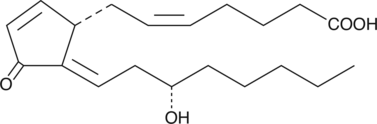
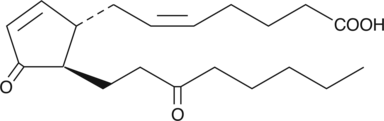

Certificates of Analysis & Batch Specific Data
Provide batch numbers separated by commas to download or request available product inserts, QC sheets, certificates of analysis, data packs, and GC-MS data.
Lipid Resource Center
Discover Products & Resources for Lipid Research
- High-purity lipid standards
- Lipid roles in biology
- Lipids in health & disease
- Lipids for pharmaceutical development
- Protocols, advice, & resources
Product Description
Prostaglandin J2 (PGJ2) is a metabolite of PGD2 (Item No. 12010) and an agonist of the prostaglandin D2 (PGD2) receptor subtypes DP1 and DP2/CRTH.1,2 It is formed from PGD2 by spontaneous dehydration.3 PGJ2 binds to DP1 and DP2/CRTH receptors (Kis = 0.9 and 6.6 nM, respectively) and either increases or inhibits the production of cAMP (EC50s = 1.2 and 13.1 nM, respectively, in HEK293 cells expressing the human receptors).1,2 PGJ2 is neurotoxic and induces apoptosis, oxidative stress, and the accumulation of ubiquitinated proteins in the brain.4 It promotes the cleavage of amyloid precursor protein (APP) by α- and β-secretase in primary rat cerebral cortical neurons when used at a concentration of 10 µM.3 The levels of PGJ2 increase in the brain after stroke or traumatic brain injury (TBI) in rodents and it accumulates in the spinal cord of patients with sporadic amyotrophic lateral sclerosis (ALS).
WARNING This product is not for human or veterinary use.
References & Product Citations
1. Characterization of the recombinant human prostanoid DP receptor and identification of L-
2. Molecular pharmacology of the human prostaglandin D2 receptor, CRTH2. Br. J. Pharmacol. 137, 1163-1172 (2002).
3. Prostaglandin J2 promotes O-
4. Prostaglandin J2: A potential target for halting inflammation-
Analytical strategy for oxylipin annotation by combining chemical derivatization-
LC-
Apolipoprotein A-
Enzymatic activity of HPGD in Treg cells suppresses Tconv cells to maintain adipose tissue homeostasis and prevent metabolic dysfunction. Immunity 50(5), 1232-1248 (2019).
Prostaglandin D2/J2 signaling pathway in a rat model of neuroinflammation displaying progressive parkinsonian-
Comprehensive high-
Synergistic antiproliferative effects of combined g-
PGH1, the precursor for the anti-
Contact Info
Cayman Chemical1180 East Ellsworth RoadAnn Arbor, Michigan 48108 USAToll Free: (800) 364-9897(USA and Canada only)Fax: (734) 971-3640


