
Technical Support & Resources
Information provided in the product description is from published literature. Due to the nature of scientific experimentation, your results (e.g., selectivity and effective concentrations) or specific application for this product may differ. If you have questions about how this product fits your application, please contact our technical support staff.
Visit our FAQ
Contact Us
Toll Free Phone (USA and Canada Only): (888) 526-5351
Direct Phone: (734) 975-3888
Product Categories
Technical Information
Shipping & Storage Information
Recommended Products
Certificates of Analysis & Batch Specific Data
Provide batch numbers separated by commas to download or request available product inserts, QC sheets, certificates of analysis, data packs, and GC-MS data.
Product Description
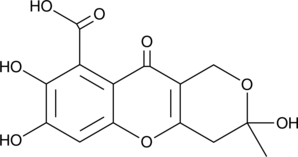
Fulvic acid is a phenolic acid and fungal metabolite originally isolated from Penicillium.1 Fulvic acids are formed via degradation of organisms and their wastes and are classified as humic substances, which are present in soil and water, can form complexes with metals, and can act as oxidizers or reducers.2,3 Fulvic acid is predicted to inhibit amyloid-β (17-42) (Aβ17-42) dimerization, disrupt preformed Aβ17-42 trimers, and bind to the catalytic site of phosphodiesterase 5A (PDE5A) based on molecular dynamics simulation studies.4,5
WARNING This product is not for human or veterinary use.
References & Product Citations
1. CXXXIX. Studies in the biochemistry of micro-
2. Fulvic acid: Modifier of metal-
3. Fulvic acid oxidation state detection using fluorescence spectroscopy. Environ. Sci. Technol. 36(14), 3170-3175 (2002).
4. The effect of fulvic acid on pre-
5. Molecular insight in to the selective inhibition of Phosphodiesterase 5A by fulvic acid (principal constituent of shilajit): Molecular dynamics simulation evidences. Int. J. Drug Design Discov. 3(4), 879-885 (2012).
Contact Info
Cayman Chemical1180 East Ellsworth RoadAnn Arbor, Michigan 48108 USAToll Free: (800) 364-9897(USA and Canada only)Fax: (734) 971-3640


