
Technical Support & Resources
Visit our FAQ
Contact Us
Toll Free Phone (USA and Canada Only): (888) 526-5351
Direct Phone: (734) 975-3888
Product Categories
Product Type
Technical Information
- Histone Deacetylase 8
Shipping & Storage Information
Recommended Products
Certificates of Analysis & Batch Specific Data
Provide batch numbers separated by commas to download or request available product inserts, QC sheets, certificates of analysis, data packs, and GC-MS data.

Visit Our Cancer Resource Center
Find Tools & Resources to Study the Hallmarks of Cancer
- Cancer cell signaling & regulation
- Cancer metabolism
- Tumor microenvironment
Product Description
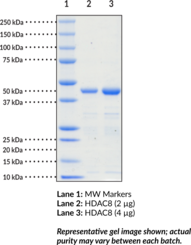
Histone deacetylase 8 (HDAC8) is a class I HDAC that catalyzes the zinc-dependent deacetylation of core histones.1,2 It is composed of a single α/β domain with an N-terminal deacetylase active site, which can be disrupted by phosphorylation of a proximal serine.3 HDAC8 is ubiquitously expressed in human tissues and, unlike most other HDACs, is localized to both the cytosol and nucleus.4 It associates with other proteins and transcription factors to regulate gene expression. HDAC8 has a flexible active site that can deacetylate lysines from both histone tails and cytosolic proteins.3 It deacetylates pyruvate kinase M2 (PKM2), inducing its relocalization to the nucleus where it binds β-catenin and promotes cyclin D1 expression and cell cycle progression in HepG2 hepatocellular carcinoma (HCC) cells.5 HDAC8 associates with RUNX family transcription factor 1 (RUNX1) and suppresses the expression of RUNX1-regulated genes, which code for proteins involved in cytokine expression, cell differentiation, cell cycle progression, and tumor suppression, in COS-7 cells.6 Inhibition of HDAC8 decreases tumor volume and increases intratumoral apoptosis without reducing body weight in a neuroblastoma mouse xenograft model.7 Cayman’s HDAC8 (human, recombinant) protein can be used for enzyme activity assay and Western blot applications.
WARNING This product is not for human or veterinary use.
References & Product Citations
1. Targeting histone deacetylase in cancer therapy. Med. Res. Rev. 26(4), 397-413 (2006).
2. Targeting histone deacetylases for the treatment of cancer and inflammatory diseases. J. Cell. Physiol. 209(3), 611-616 (2006).
3. Structural snapshots of human HDAC8 provide insights into the class I histone deacetylases. Structure 12(7), 1325-1334 (2004).
4. Roles and regulation of histone acetylation in hepatocellular carcinoma. Front. Genet. 13, 982222 (2022).
5. HDAC8-
6. The inv(16) fusion protein associates with corepressors via a smooth muscle myosin heavy-
7. Selective inhibition of HDAC8 decreases neuroblastoma growth in vitro and in vivo and enhances retinoic acid-
Contact Info
Cayman Chemical1180 East Ellsworth RoadAnn Arbor, Michigan 48108 USAToll Free: (800) 364-9897(USA and Canada only)Fax: (734) 971-3640


