
Technical Support & Resources
Visit our FAQ
Contact Us
Toll Free Phone (USA and Canada Only): (888) 526-5351
Direct Phone: (734) 975-3888
Product Categories
Product Type
Diphtheria Toxin (unnicked) from Corynebacterium diphtheriae
Item No. 19657
Technical Information
Shipping & Storage Information
Recommended Products
Certificates of Analysis & Batch Specific Data
Provide batch numbers separated by commas to download or request available product inserts, QC sheets, certificates of analysis, data packs, and GC-MS data.
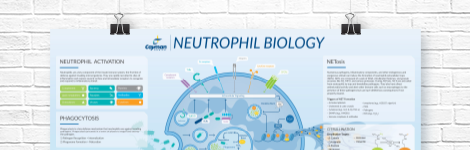
Neutrophil Biology Wall Poster
Explore how neutrophils shape the immune response in health and disease. This poster highlights neutrophil pathogen defense mechanisms, including phagocytosis, degranulation, and NETosis, as well as neutrophil roles in inflammation and NET-associated pathologies.
DOWNLOAD NOWProduct Description
Diphtheria toxin is a toxin produced by C. diphtheriae that catalyzes the ADP-ribosylation and inactivation of translation elongation factor 2 (EF-2). It is synthesized and excreted as a proenzyme and must undergo two covalent alterations in structure in order to be active. First, mild proteolysis results in the formation of “nicked toxin”, which is enzymatically inactive and consists of two major fragments, A and B. Reduction of the nicked toxin with thiols releases the N-terminal A fragment, which is enzymatically active. The C-terminal B fragment binds to specific host receptors and translocates the catalytic domain into the cell.1 After binding to the cell receptor, the diphtheria toxin is taken up by endocytosis, the pH of the endocytic vesicle drops, and the translocation region of the toxin helps guide the catalytic domain into the host cytoplasm where it is released.2 Within the cytoplasm, the diphtheria toxin catalytic domain ADP ribosylates EF-2, terminating protein synthesis and causing cell death.3
WARNING This product is not for human or veterinary use.
References & Product Citations
1. pH-
2. Mechanism of diphtheria toxin catalytic domain delivery to the eukaryotic cell cytosol and the cellular factors that directly participate in the process. Toxins (Basel) 3(3), 294-308 (2011).
3. Intracellular mono-
Contact Info
Cayman Chemical1180 East Ellsworth RoadAnn Arbor, Michigan 48108 USAToll Free: (800) 364-9897(USA and Canada only)Fax: (734) 971-3640


