
Features
- Each vial contains a mixture of standards packaged in amber ampules purged with argon
- >1 ml provided at the concentration specified in the insert
- Designed for direct snap and inject use in mass spectrometry applications
- Ideally suited for method development and as a system suitability standard
Technical Support & Resources
Visit our FAQ
Contact Us
Toll Free Phone (USA and Canada Only): (888) 526-5351
Direct Phone: (734) 975-3888
Product Categories
Application
Technical Information
Shipping & Storage Information
Recommended Products
Certificates of Analysis & Batch Specific Data
Provide batch numbers separated by commas to download or request available product inserts, QC sheets, certificates of analysis, data packs, and GC-MS data.
Lipid Resource Center
Discover Products & Resources for Lipid Research
- High-purity lipid standards
- Lipid roles in biology
- Lipids in health & disease
- Lipids for pharmaceutical development
- Protocols, advice, & resources
Product Description
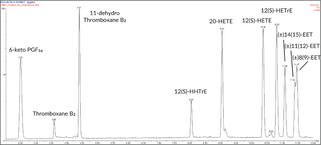
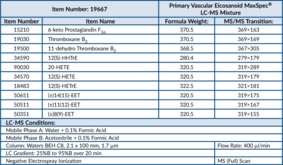
This mixture contains a collection of vasoactive eicosanoids, including the characteristic metabolites of both prostaglandin I2 (PGI2; Item No. 18220) and thromboxane A2 (TXA2), as well as several additional HETE and EET metabolites produced by platelets and the cytochrome P450 pathway of arachidonic acid metabolism. The mixture is supplied in an amber ampule in which the headspace has been purged with argon to prevent lipid oxidation. This product has been designed for direct use in LC-MS applications. The solution may be serially diluted for preparation of calibrators and QC standards and/or used directly as a system suitability standard or tuning standard. After opening, we recommend that the mixture be transferred immediately to a 1 ml glass screw cap vial, to prevent solvent evaporation, and stored at -20°C. The mixture should be discarded after multiple freeze/thaw cycles.
Whereas PGI2 is a potent vasodilator and inhibitor of human platelet aggregation, TXA2 causes irreversible platelet aggregation and contraction of vascular and bronchial smooth muscle. Because both are rapidly hydrolyzed and metabolized, TXB2 (Item No. 19030), 11-dehydro TXB2 (Item No. 19500), and 6-keto PGF1α (Item No. 15210) serve as useful markers for their synthesis.1,2 Certain HETEs and EETs have been shown to either inhibit platelet activation or regulate vasoconstriction.3,4,5,6,7,8,9
WARNING This product is not for human or veterinary use.
References & Product Citations
1. Fractional conversion of thromboxane B2 to urinary 11-
2. Metabolic disposition of prostacyclin in humans. J. Pharmacol. Exp. Ther. 226(1), 78-87 (1983).
3. Prostaglandin endoperoxides. Novel transformations of arachidonic acid in human platelets. Proc. Natl. Acad. Sci. USA 71(9), 3400-3404 (1974).
4. Conversion of prostaglandin endoperoxides to C17-
5. Investigations of human platelet-
6. 20-
7. Glomerular stereospecific synthesis and hemodynamic actions of 8,9-
8. Recovery of Ca2+ pools and growth in Ca2+ pool-
9. Endogenous biosynthesis of arachidonic acid epoxides in humans: Increased formation in pregnancy-
Contact Info
Cayman Chemical1180 East Ellsworth RoadAnn Arbor, Michigan 48108 USAToll Free: (800) 364-9897(USA and Canada only)Fax: (734) 971-3640


