
Technical Support & Resources
Visit our FAQ
Contact Us
Toll Free Phone (USA and Canada Only): (888) 526-5351
Direct Phone: (734) 975-3888
Product Categories
Product Type
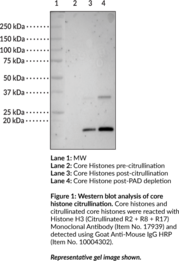
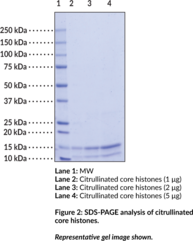
Technical Information
Shipping & Storage Information
Recommended Products
Certificates of Analysis & Batch Specific Data
Provide batch numbers separated by commas to download or request available product inserts, QC sheets, certificates of analysis, data packs, and GC-MS data.
NET Formation Screening & Analysis Services
Our experts are here to help.
- Detection of NET formation ex vivo and screening for modulators using:
- High-content imaging
- Enzymatic detection
- Citrullination/carbamylation detection
- Experienced scientists skilled in neutrophil biology, isolation, and handling
Product Description
Nucleosomes are the basic repeating units of chromatin in which DNA is wrapped twice around a histone octamer consisting of two copies of each of the core histones, H2A, H2B, H3, and H4.1 Peripheral proteins, including the histone H1, interact with nucleosomes to affect chromatin structure. Histones undergo many modifications, which include acetylation, methylation, and phosphorylation, that are important for the regulation of gene transcription.1 Citrullination is another important post-translational modification that is catalyzed by the pepitylarginine deiminases PAD4 and PAD2. Hypercitrullination of histones leads to the development of neutrophil extracellular traps (NETs), which are a part of the inflammatory response.2,3 Neutrophils release these NETs to trap and eradicate bacteria and fungi. Failure to clear citrullinated proteins and NET components following inflammation can result in the production of autoantibodies and anti-citrullinated protein antibodies.4 The persistence of these antibodies and citrullinated proteins is associated with a number of human diseases including rheumatoid arthritis, systemic lupus erythematosus, Alzheimer’s disease, and multiple sclerosis.5 This product contains a mixture of H1, H2A, H2B, H3, and H4 histones isolated from calf thymus. The mixture is modified by PAD4 enzyme, which is subsequently depleted by affinity chromatography.
WARNING This product is not for human or veterinary use.
References & Product Citations
1. Covalent modifications of histones during development and disease pathogenesis. Nat. Struct. Mol. Biol. 14(11), 1008-1016 (2007).
2. Citrullination under physiological and pathological conditions. Joint Bone Spine 79(5), 431-436 (2012).
3. Knotting the NETs: Analyzing histone modifications in neutrophil extracellular traps. Arthirits Res. Ther. 14(2), 1-2 (2012).
4. Peptidyl arginine deiminase type 2 (PAD-
5. Role for peptidylarginine deiminase enzymes in disease and female reproduction. J. Reprod. Dev. 58(3), 274-282 (2012).
Contact Info
Cayman Chemical1180 East Ellsworth RoadAnn Arbor, Michigan 48108 USAToll Free: (800) 364-9897(USA and Canada only)Fax: (734) 971-3640


