
Technical Support & Resources
Visit our FAQ
Contact Us
Toll Free Phone (USA and Canada Only): (888) 526-5351
Direct Phone: (734) 975-3888
Product Categories
Product Type
Technical Information
- Anchorin CII
- Annexin A5
- Calphobindin I
- Endonexin II
- Lipocortin V
- PP4
Shipping & Storage Information
Recommended Products
Certificates of Analysis & Batch Specific Data
Provide batch numbers separated by commas to download or request available product inserts, QC sheets, certificates of analysis, data packs, and GC-MS data.

Visit Our Cancer Resource Center
Find Tools & Resources to Study the Hallmarks of Cancer
- Cancer cell signaling & regulation
- Cancer metabolism
- Tumor microenvironment
Product Description
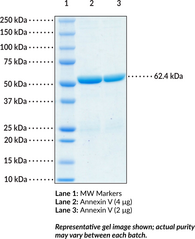
Annexin V is a soluble membrane-binding protein encoded by the ANXA5 gene in humans that binds to negatively charged phospholipids, such as phosphatidylserine (PS), in a calcium-dependent manner.1,2,3 It is expressed in a wide variety of tissues but is detected primarily in placenta and vascular endothelium.4 Annexin V is comprised of a variable N-terminal domain and four highly conserved annexin repeats that form the membrane-binding core.1,5 Upon membrane binding, annexin V forms a two-dimensional lattice that is stabilized by protein-protein interactions.2,5 In activated platelets and apoptotic cells, plasma membrane asymmetry, but not integrity, is disrupted and PS becomes exposed at the cell surface, following which annexin V binds to the surface-exposed PS and inhibits its procoagulant and pro-inflammatory activities.2,4,6,7 Because of its affinity for PS in apoptotic cell membranes, fluorescent and affinity-labeled versions of annexin V have been used in affinity assays for the detection and quantification of apoptotic cells.7 Annexin V levels are elevated in tumor tissue from patients with a variety of cancers, including follicular thyroid adenoma, papillary thyroid carcinoma, cervical squamous cell carcinoma, and colorectal cancer.5 Cayman's Annexin V (human, recombinant) protein can be used for Western blot, ELISA, and cell-based assays.
WARNING This product is not for human or veterinary use.
References & Product Citations
1. Review: Annexin-
2. Annexin V, the regulator of phosphatidylserine-
3. A common haplotype of the annexin A5 (ANXA5) gene promoter is associated with recurrent pregnancy loss. Hum. Mol. Genet. 16(5), 573-578 (2007).
4. Anti-
5. Annexin A5 as a potential marker in tumors. Clin. Chim. Acta 427, 42-48 (2014).
6. Clustering of lipid-
7. Annexin V-
Contact Info
Cayman Chemical1180 East Ellsworth RoadAnn Arbor, Michigan 48108 USAToll Free: (800) 364-9897(USA and Canada only)Fax: (734) 971-3640


