
Technical Support & Resources
Visit our FAQ
Contact Us
Toll Free Phone (USA and Canada Only): (888) 526-5351
Direct Phone: (734) 975-3888
Product Categories
Technical Information
- 5-mC
- m5C
- NSC 137776
Shipping & Storage Information
Recommended Products
Certificates of Analysis & Batch Specific Data
Provide batch numbers separated by commas to download or request available product inserts, QC sheets, certificates of analysis, data packs, and GC-MS data.

Visit Our Cancer Resource Center
Find Tools & Resources to Study the Hallmarks of Cancer
- Cancer cell signaling & regulation
- Cancer metabolism
- Tumor microenvironment
Product Description
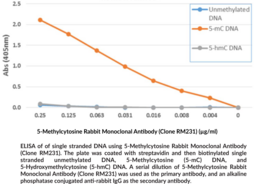
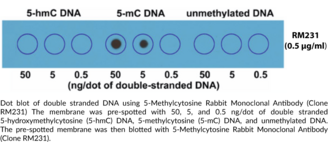
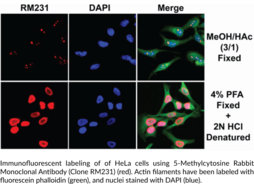
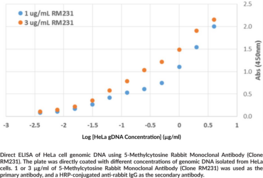
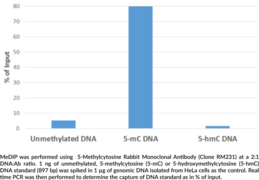
5-Methylcytosine (5-mC) is an epigenetic modification formed from methylation of cytosine by DNA methyltransferases (DNMTs).1 5-mC is an abundant DNA modification that is enriched at CpG dinucleotides. It can be successively oxidized by ten-eleven translocation (TET) dioxygenases to form 5-hydroxymethylcytosine (5-hmC), 5-formylcytosine (5-fC), and 5-carboxylcytosine (5-caC). 5-mC is associated with reduced gene transcription of DNA but is also found in the tRNA, mRNA, and rRNA from bacteria, archaea, and eukaryotes.1,2 Levels of 5-mC on CpG islands in the genes encoding p16, thrombospondin-1 (TSP-1), and methylated in tumor 1 (MINT1) are increased in tumors compared with adjacent normal tissue in patients with renal cell carcinoma.3 Cayman’s 5-Methylcytosine Rabbit Monoclonal Antibody (Clone RM231) can be used for ELISA, dot blot, flow cytometry (FC), immunocytochemistry (ICC), and methylated DNA immunoprecipitation (MeDIP) applications.
WARNING This product is not for human or veterinary use.
References & Product Citations
1. Epigenetic regulatory functions of DNA modifications: 5-
2. Transcriptome-
3. Regional DNA hypermethylation and DNA methyltransferase (DNMT) 1 protein overexpression in both renal tumors and corresponding nontumorous renal tissues. Int. J. Cancer 119(2), 288-296 (2006).
Contact Info
Cayman Chemical1180 East Ellsworth RoadAnn Arbor, Michigan 48108 USAToll Free: (800) 364-9897(USA and Canada only)Fax: (734) 971-3640


