
Technical Support & Resources
Visit our FAQ
Contact Us
Toll Free Phone (USA and Canada Only): (888) 526-5351
Direct Phone: (734) 975-3888
Product Categories
Research Area
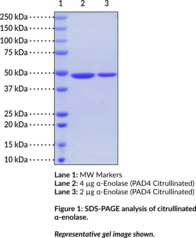
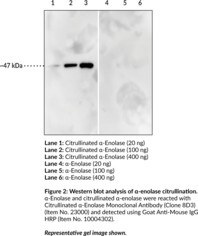
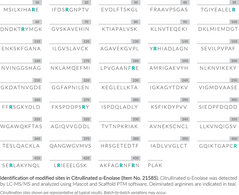
Technical Information
- Enolase-1
Shipping & Storage Information
Recommended Products
Certificates of Analysis & Batch Specific Data
Provide batch numbers separated by commas to download or request available product inserts, QC sheets, certificates of analysis, data packs, and GC-MS data.
Product Description
α-Enolase, also known as enolase-1, is a glycolytic enzyme that catalyzes the conversion of 2-phosphoglycerate to phosphoenolpyruvate.1 It is ubiquitously expressed in human tissues, including liver, spleen, kidney, and brain. In cells, α-enolase is primarily localized to the cytoplasm, however, an alternatively translated form localizes to the nucleus and lacks glycolytic enzyme activity.1,2 α-Enolase functions as a cell surface receptor for plasminogen on pathogens and activated immune cells, as an oxidative stress protein in endothelial cells, and as a chromatin binding partner to facilitate transcription.2,3,4 It is an autoantigen in asthma, Hashimoto's encephalopathy, and rheumatoid arthritis, and has been found in the serum of pediatric patients with juvenile idiopathic arthritis.5,6,7,8 α-Enolase is also subject to citrullination by peptidyl arginine deiminases (PADs) and citrullinated α-enolase has been found in the synovial fluid of rheumatoid arthritis patients.7
WARNING This product is not for human or veterinary use.
References & Product Citations
1. ENO1 promotes tumor proliferation and cell adhesion mediated drug resistance (CAM-
2. Alpha-
3. Structural analysis of α-
4. Surface α-
5. Identification of α-
6. Measurement and evaluation of isotypes of anti-
7. High prevalence of serum autoantibodies against the amino terminal of α-
8. Timosaponin AIII induces antiplatelet and antithrombotic activity via Gq-
Citrullinated vimentin and alpha enolase are expressed at the cell surface of apoptotic human neutrophils. Hum. Immunol. 87(1), 111631 (2026).
Cytotoxic CD8+ T cells target citrullinated antigens in rheumatoid arthritis. Nat. Commun. 14(1), 319 (2023).
Contact Info
Cayman Chemical1180 East Ellsworth RoadAnn Arbor, Michigan 48108 USAToll Free: (800) 364-9897(USA and Canada only)Fax: (734) 971-3640


