
Technical Support & Resources
Visit our FAQ
Contact Us
Toll Free Phone (USA and Canada Only): (888) 526-5351
Direct Phone: (734) 975-3888
Product Categories
Product Type
Technical Information
- Heat Shock Protein 32
- Heme Oxygenase-1
- HMOX1
- Hsp32
Shipping & Storage Information
Recommended Products
Certificates of Analysis & Batch Specific Data
Provide batch numbers separated by commas to download or request available product inserts, QC sheets, certificates of analysis, data packs, and GC-MS data.

Visit Our Cancer Resource Center
Find Tools & Resources to Study the Hallmarks of Cancer
- Cancer cell signaling & regulation
- Cancer metabolism
- Tumor microenvironment
Product Description
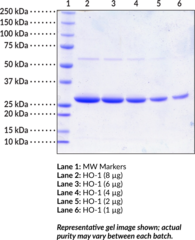
Heme oxygenase-1 (HO-1), also known as heat shock protein 32 (Hsp32), is an inducible heme oxygenase encoded by the HMOX1 gene.1,2,3 It is a membrane-bound enzyme that catalyzes the cleavage of heme to release carbon monoxide (CO), ferrous ions (Fe2+), and biliverdin, with biliverdin being further processed into bilirubin. HO-1 is found in human spleen, liver, and kidney where its expression is induced by the presence of heme, hormones, metals, oxidative agents, and therapeutic compounds to protect against oxidative stress and inflammatory responses. HO-1 is upregulated in a variety of cancers and siRNA knockdown of HMOX1 or inhibition of HO-1 decreases cancer cell proliferation.4,5,6 HO-1 also interacts with the severe acute respiratory syndrome coronavirus 2 (SARS-CoV-2) accessory protein Orf3a that, in a similar virus, SARS-CoV, is associated with activation of the NLRP3 inflammasome.7,8,9 Cayman’s HO-1 protein can be used for ELISA and Western blot (WB) applications.
WARNING This product is not for human or veterinary use.
References & Product Citations
1. Regiospecificity determinants of human heme oxygenase. The Journal of Biological Chemisty 280(4), 2797-2806 (2005).
2. Properties of human kidney heme oxygenase: Inhibition by synthetic heme analogues and metalloporphyrins. Biochem. Biophys. Res. Commun. 157(2), 480-487 (1988).
3. Measurement of membrane-
4. Inhibition of heme oxygenase-
5. Heme oxygenase-
6. Antiapoptotic role of heme oxygenase (HO) and the potential of HO as a target in anticancer treatment. Apoptosis 9(1), 27-35 (2004).
7. A SARS-
8. Coronavirus disease 2019 (COVID-
9. Severe acute respiratory syndrome coronavirus ORF3a protein activates the NLRP3 inflammasome by promoting TRAF3-
Contact Info
Cayman Chemical1180 East Ellsworth RoadAnn Arbor, Michigan 48108 USAToll Free: (800) 364-9897(USA and Canada only)Fax: (734) 971-3640


