
Technical Support & Resources
Visit our FAQ
Contact Us
Toll Free Phone (USA and Canada Only): (888) 526-5351
Direct Phone: (734) 975-3888
Product Categories
Product Type
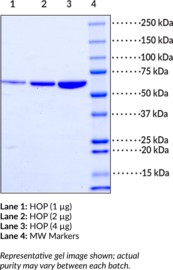
Technical Information
- Hsp70/Hsp90 Organizing Protein
- Stress-Induced Phosphoprotein
Shipping & Storage Information
Recommended Products
Certificates of Analysis & Batch Specific Data
Provide batch numbers separated by commas to download or request available product inserts, QC sheets, certificates of analysis, data packs, and GC-MS data.
Product Description
HOP (Hsp70/Hsp90 Organizing Protein), also known as Stress-Induced Phosphoprotein 1 (STI1 or STIP1), acts as a co-chaperone to reversibly form a complex with Hsp70 and Hsp90 to assist in transfer of proteins between Hsp70 and Hsp90. The three tetratricopeptide repeat domains (TPR1, TPR2a, and TPR2b) act as binding regions, with TPR1 and TPR2B binding to Hsp70 and TPR2A binding to Hsp90. 1 Highly conserved in Eukaryotes, it is closely related to the yeast STI1. HOP is both a nuclear and cytoplasmic protein, capable of travel between both. 2 HOP has also been found to interact with several other proteins/complexes, including but not limited to: Hsc70, Hsp90α, Hsp90β, PACRG, METTL21B, FLCN, FNIP1, and FNIP2. 3,4,5,6,7
WARNING This product is not for human or veterinary use.
References & Product Citations
1. Definition of the minimal fragments of Sti1 required for dimerization, interaction with Hsp70 and Hsp90 and in vivo functions. Biochem J. 404(1), 159-167 (2007).
2. The architecture of functional modules in the Hsp90 co-
3. Aha1 competes with Hop, p50 and p23 for binding to the molecular chaperone Hsp90 and contributes to kinase and hormone receptor activation. Biochem J. 387(Pt. 3), 789-796 (2005).
4. A product of the human gene adjacent to parkin is a component of Lewy bodies and suppresses Pael receptor-
5. A newly uncovered group of distantly related lysine methyltransferases preferentially interact with molecular chaperones to regulate their activity. PLoS Genet. 9(1), 1-13 (2013).
6. Protein phosphatase 5 is a major component of glucocorticoid receptor.hsp90 complexes with properties of an FK506-
7. The FNIP co-
Contact Info
Cayman Chemical1180 East Ellsworth RoadAnn Arbor, Michigan 48108 USAToll Free: (800) 364-9897(USA and Canada only)Fax: (734) 971-3640


