
Technical Support & Resources
Visit our FAQ
Contact Us
Toll Free Phone (USA and Canada Only): (888) 526-5351
Direct Phone: (734) 975-3888
Product Categories
Product Type
Technical Information
- Heat Shock Protein 27
Shipping & Storage Information
Recommended Products
Certificates of Analysis & Batch Specific Data
Provide batch numbers separated by commas to download or request available product inserts, QC sheets, certificates of analysis, data packs, and GC-MS data.
Product Description
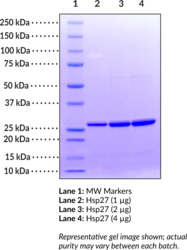
Heat shock protein 27 (Hsp27), also known as heat shock protein beta-1 (HspB1), is a member of the small heat shock protein (sHSP) family that is upregulated during conditions of cellular stress including heat shock, radiation, hypoxia, and exposure to reactive oxygen species (ROS).1,2 It is composed of an N-terminal domain, a highly conserved alpha-crystallin domain, and a C-terminal domain. Hsp27 functions as a molecular chaperone to prevent protein aggregation in an ATPase-independent manner. This chaperone activity is altered by changes in oligomerization state or by post-translational modifications including phosphorylation at serine residues 15 and 82, which increases affinity for damaged polypeptides in response to heat shock.3 Hsp27 also works in complex with other chaperone proteins, such as Hsp70 (Item Nos. 22739 | 23002), to correct misfolded proteins. This protein also plays a role in apoptosis, proteasome activation, cell differentiation, and has been shown to interact with actin and intermediate filaments.4,5,6 Mutations in HSPB1 have been linked to hereditary neuromuscular diseases and cause Charcot-Marie-Tooth Disease Type 2 (CMT-2).7
WARNING This product is not for human or veterinary use.
References & Product Citations
1. Molecular chaperone functions of heat-
2. Heat shock proteins. The Journal of Biological Chemisty 265(21), 12111-12114 (1990).
3. The growing world of small heat shock proteins: From structure to functions. Cell Stress Chaperones 22(4), 601-611 (2017).
4. Inhibition of HSP70: A challenging anti-
5. Increased expression of the Mr 27,000 heat shock protein (hsp27) in in vitro differentiated normal human keratinocytes. Cell Growth Differ. 5(7), 777-781 (1994).
6. Vascular endothelial growth factor (VEGF)-
7. Mutant small heat-
Contact Info
Cayman Chemical1180 East Ellsworth RoadAnn Arbor, Michigan 48108 USAToll Free: (800) 364-9897(USA and Canada only)Fax: (734) 971-3640


