
Technical Support & Resources
Visit our FAQ
Contact Us
Toll Free Phone (USA and Canada Only): (888) 526-5351
Direct Phone: (734) 975-3888
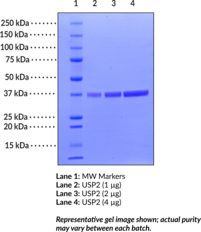
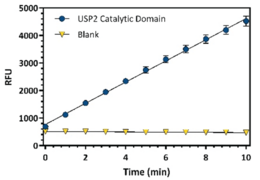
Technical Information
- Ubiquitin C-terminal Hydrolase 2
- Ubiquitin-specific Protease 2
Shipping & Storage Information
Recommended Products
Certificates of Analysis & Batch Specific Data
Provide batch numbers separated by commas to download or request available product inserts, QC sheets, certificates of analysis, data packs, and GC-MS data.

Visit Our Cancer Resource Center
Find Tools & Resources to Study the Hallmarks of Cancer
- Cancer cell signaling & regulation
- Cancer metabolism
- Tumor microenvironment
Product Description
Ubiquitin-specific protease 2 (USP2), also known as ubiquitin carboxyl-terminal hydrolase 2, is a cysteine protease involved in intracellular protein degradation by deubiquitinating degraded protein, including Mdm2, Mdm4, and CCND1.1,2,3 In both normal and cancer cells, it regulates G1/S cell-cycle transition.2 It may regulate p53-dependent pathways by deubiquitinating Mdm2, indirectly promoting p53 degradation and limiting its activity.1,4,5. Regulated by androgen, USP2 is over-expressed in prostate cancer and stabilizes fatty acid synthase (FASN), which is associated with the malignancy of some aggressive prostate cancers.4,6 Some of these oncogenic properties may be linked to its deubiquitinating activity. One hypothesis is that USP2 may stabilize short-lived proteins that may act to induce apoptosis.7 USP2 has also been shown to regulate the intrinsic circadian rhythm and its capacity to respond to external cues, in a non-degradative manner by acting on the core clock component PER1.8 This protein is a truncation containing the active catalytic domain (residues 259-605) of USP2 and a C-terminal His-tag.
WARNING This product is not for human or veterinary use.
References & Product Citations
1. The deubiquitinating enzyme USP2a regulates the p53 pathway by targeting Mdm2. EMBO J. 26(4), 976-986 (2007).
2. Suppression of cancer cell growth by promoting cyclin D1 degradation. Mol. Cell. 36(3), 469-476 (2009).
3. MdmX is a substrate for the deubiquitinating enzyme USP2a. Oncogene 29(3), 432-441 (2010).
4. The isopeptidase USP2a protects human prostate cancer from apoptosis. Cancer Res. 66(17), 8625-8632 (2006).
5. Structural basis of ubiquitin recognition by the deubiquitinating protease USP2. Structure 14(8), 1293-1302 (2006).
6. The isopeptidase USP2a regulates the stability of fatty acid synthase in prostate cancer. Cancer Cell 593), 253-261 (2004).
7. UBP41 is a proapoptotic ubiquitin-
8. A central role for ubiquitination within a circadian clock protein modification code. Front. Mol. Neurosci. 7(69), (2014).
Contact Info
Cayman Chemical1180 East Ellsworth RoadAnn Arbor, Michigan 48108 USAToll Free: (800) 364-9897(USA and Canada only)Fax: (734) 971-3640


