
Technical Support & Resources
Visit our FAQ
Contact Us
Toll Free Phone (USA and Canada Only): (888) 526-5351
Direct Phone: (734) 975-3888
Product Categories
Product Type
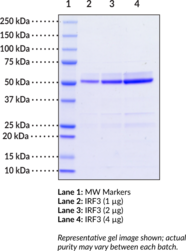
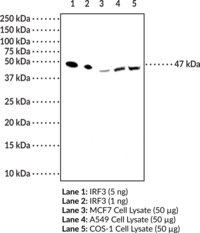
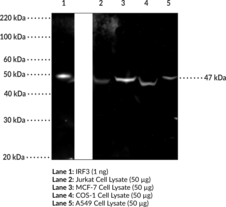
Technical Information
- Interferon Regulatory Factor 3
Shipping & Storage Information
Recommended Products
Certificates of Analysis & Batch Specific Data
Provide batch numbers separated by commas to download or request available product inserts, QC sheets, certificates of analysis, data packs, and GC-MS data.
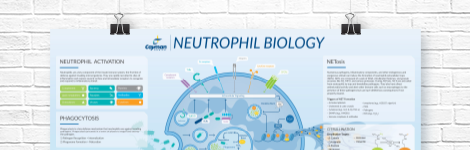
Neutrophil Biology Wall Poster
Explore how neutrophils shape the immune response in health and disease. This poster highlights neutrophil pathogen defense mechanisms, including phagocytosis, degranulation, and NETosis, as well as neutrophil roles in inflammation and NET-associated pathologies.
DOWNLOAD NOWProduct Description
Interferon regulatory factor 3 (IRF3) is a member of the IRF family. It plays a crucial role in activation of innate immunity and inflammation in response to viral infection, functioning as a molecular switch for antiviral activity.1,2,3,4,5 Double-stranded RNA generated during a viral infection leads to IRF3 activation by serine/threonine phosphorylation by TBK1 or IKBKE kinases, which induces a conformational change leading to its dimerization, nuclear localization, and association with CREBBP.1,2,3,6 The complex, known as DRAF1, activates transcription interferons alpha and beta, as well as other interferon-induced genes.1,6 These genes play a critical role in type 1 interferon (IFN)-dependent immune response.5 A recent study shows phosphorylation of innate immune adaptor proteins MAVS, STING, and TRIF recruits and specifies IRF3 phosphorylation and activation by the serine/threonine-protein kinase TBK1, thereby inducing the production of type-1 interferons.2,4,7
WARNING This product is not for human or veterinary use.
References & Product Citations
1. Structural insights into the functions of TBK1 in innate antimicrobial immunity. Structure 21(7), 1137-1148 (2013).
2. SIKE is an IKKε/TBK1-
3. Recognition of the measles virus nucleocapsid as a mechanism of IRF-
4. VISA is an adapter protein required for virus-
5. The impact of the interferon/TNF-
6. Human DEAD box helicase 3 couples IκB kinase ε to interferon regulatory factor 3 activation. Mol. Cell. Biol. 33(10), 2004-2015 (2013).
7. Phosphorylation of innate immune adaptor proteins MAVS, STING, and TRIF induces IRF3 activation. Science 347(6227), aaa2630 (2015).
Contact Info
Cayman Chemical1180 East Ellsworth RoadAnn Arbor, Michigan 48108 USAToll Free: (800) 364-9897(USA and Canada only)Fax: (734) 971-3640


