
Technical Support & Resources
Visit our FAQ
Contact Us
Toll Free Phone (USA and Canada Only): (888) 526-5351
Direct Phone: (734) 975-3888
Product Categories
Product Type
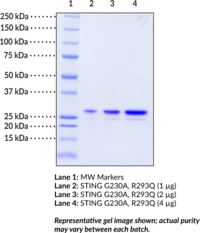
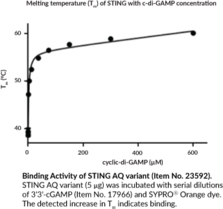
Technical Information
- Endoplasmic Reticulum Interferon Stimulator
- Stimulator of Interferon Genes
- TMEM173
Shipping & Storage Information
Recommended Products
Certificates of Analysis & Batch Specific Data
Provide batch numbers separated by commas to download or request available product inserts, QC sheets, certificates of analysis, data packs, and GC-MS data.
Neutrophil Biology Wall Poster
Explore how neutrophils shape the immune response in health and disease. This poster highlights neutrophil pathogen defense mechanisms, including phagocytosis, degranulation, and NETosis, as well as neutrophil roles in inflammation and NET-associated pathologies.
DOWNLOAD NOWProduct Description
STING AQ variant (human recombinant) contains amino acids 138-379 of the wild-type STING variant (R232) with an alanine substituted for glycine at position 230 and a glutamine substituted for arginine at position 293. Stimulator of interferon genes (STING) is a component of the innate immune response that binds to cyclic dinucleotides, which are bacterial second messengers.1 Recognition of cyclic-di-GMP (c-di-GMP), c-di-AMP, or c-GMP-AMP leads to activation of NF-κB and transcription of immunomodulatory genes, including type I interferons (IFN).2,3,4 The R232 variant of STING is the most common variant in the human population, found at a frequency of 57.9% in the 1000 Genome Project.5 The SNP variant H232 is found at a 13.7% frequency. The G230A, R293Q double mutation occurs in 5.2% of the human population and when expressed in HEK293T cells, this mutation reduces the IFN response to bacterial ligands by 30-40% compared to wild-type STING. Whereas the R293Q substitution alone is severely defective in response to bacterial cyclic dinucleotides, the G230A substitution is thought to help maintain some ability of this variant to respond to bacterial cyclic dinucleotides. Based on crystal structure of STING, the G230A mutation alters the conformation of the lid region that clamps onto the c-di-GMP, however, the R293 residue does not directly bind to c-di-GMP.5 The R293Q mutation may instead disrupt STING activity indirectly by altering the function of a nearby cysteine residue required for IFN-β expression.6
WARNING This product is not for human or veterinary use.
References & Product Citations
1. STING is a direct innate immune sensor of cyclic-
2. Cyclic GMP-
3. Cyclic GMP-
4. Cyclic dinucleotides trigger ULK1 (ATG1) phosphorylation of STING to prevent sustained innate immune signaling. Cell 155(3), 688-698 (2013).
5. Single nucleotide polymorphisms of human STING can affect innate immune response to cyclic dinucleotides. PLoS One 8(10), e77846 (2013).
6. Identification and characterization of a loss-
Contact Info
Cayman Chemical1180 East Ellsworth RoadAnn Arbor, Michigan 48108 USAToll Free: (800) 364-9897(USA and Canada only)Fax: (734) 971-3640


