
Technical Support & Resources
Information provided in the product description is from published literature. Due to the nature of scientific experimentation, your results (e.g., selectivity and effective concentrations) or specific application for this product may differ. If you have questions about how this product fits your application, please contact our technical support staff.
Visit our FAQ
Contact Us
Toll Free Phone (USA and Canada Only): (888) 526-5351
Direct Phone: (734) 975-3888
Product Categories
Technical Information
Shipping & Storage Information
Recommended Products
Certificates of Analysis & Batch Specific Data
Provide batch numbers separated by commas to download or request available product inserts, QC sheets, certificates of analysis, data packs, and GC-MS data.

Visit Our Cancer Resource Center
Find Tools & Resources to Study the Hallmarks of Cancer
- Cancer cell signaling & regulation
- Cancer metabolism
- Tumor microenvironment
Product Description
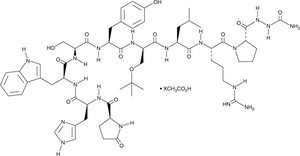
Goserelin is a synthetic gonadotropin-releasing hormone (GNRH) agonist that binds to the GNRH receptor (GNRHR; Ki = 1.6 nM, in CHO cells expressing the human receptor).1 It binds to mouse pituitary αT3-1 cells and human placenta (Kds = 2 and 580 nM, respectively) and increases intracellular calcium in αT3-1 cells.2 Goserelin induces testosterone production in vitro within 4 h in rat Leydig cells (ED50 = 83 nM) but decreases testosterone plasma level in vivo in rats over a period of 2 to 24 weeks.3,4 It inhibits tumor growth in a DU145 human prostate carcinoma mouse xenograft model when administered at a dose of 100 μg per day.5 Formulations containing goserelin have been used in the treatment of hormone-dependent breast and prostate cancers, as well as endometriosis and uterine fibroids.
WARNING This product is not for human or veterinary use.
References & Product Citations
1. Characterization of 12 GnRH peptide agonists -
2. The expression of gonadotropin-
3. The role of calcium in luteinizing hormone-
4. Prolonged suppression of rat testis function by a depot formulation of Zoladex, a GnRH agonist. J. Androl. 10(6), 478-486 (1989).
5. Growth-
Contact Info
Cayman Chemical1180 East Ellsworth RoadAnn Arbor, Michigan 48108 USAToll Free: (800) 364-9897(USA and Canada only)Fax: (734) 971-3640


