
Technical Support & Resources
Information provided in the product description is from published literature. Due to the nature of scientific experimentation, your results (e.g., selectivity and effective concentrations) or specific application for this product may differ. If you have questions about how this product fits your application, please contact our technical support staff.
Visit our FAQ
Contact Us
Toll Free Phone (USA and Canada Only): (888) 526-5351
Direct Phone: (734) 975-3888

Technical Information
- Pam3Cys-Ser-(Lys)4
Shipping & Storage Information
Recommended Products
Certificates of Analysis & Batch Specific Data
Provide batch numbers separated by commas to download or request available product inserts, QC sheets, certificates of analysis, data packs, and GC-MS data.
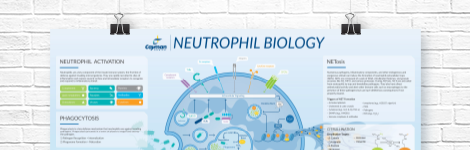
Neutrophil Biology Wall Poster
Explore how neutrophils shape the immune response in health and disease. This poster highlights neutrophil pathogen defense mechanisms, including phagocytosis, degranulation, and NETosis, as well as neutrophil roles in inflammation and NET-associated pathologies.
DOWNLOAD NOWProduct Description
Pam3CSK4 is a synthetic bacterial lipopeptide that binds to and acts as an agonist at toll-like receptor 2 (TLR2).1 It induces proliferation of isolated mouse spleen cells and activates lymphocytes at a concentration of 50 µg/ml.2 Pam3CSK4 is a potent immune adjuvant in mice, enhancing the response to antigen, as measured by IgM and IgG levels, when used at a dose of 200 µg/animal. It inhibits Th1 and Th2 responses, suppresses eosinophil infiltration, and induces CD4+ T cell apoptosis in a mouse model of allergic conjunctivitis.3 Pam3CSK4 (50 µg) decreases lesion size and parasite burden in genetically-resistant and -susceptible mice when administered with L. major to induce leishmaniasis.4 It also enhances Th1 responses and stimulates IL-17 production in the early phase of infection.
WARNING This product is not for human or veterinary use.
References & Product Citations
1. TLR2 recognizes a bacterial lipopeptide through direct binding. J. Immunol. 173(12), 7401-7405 (2004).
2. Lipopeptide derivatives of bacterial lipoprotein constitute potent immune adjuvants combined with or covalently coupled to antigen or hapten. Biol. Chem. Hoppe Seyler 370(4), 343-352 (1989).
3. TLR2 agonist ameliorates murine experimental allergic conjunctivitis by inducing CD4 positive T-
4. Coinjection with TLR2 agonist Pam3CSK4 reduces the pathology of leishmanization in mice. PLoS Negl. Trop. Dis. 9(3), e0003546 (2015).
Contact Info
Cayman Chemical1180 East Ellsworth RoadAnn Arbor, Michigan 48108 USAToll Free: (800) 364-9897(USA and Canada only)Fax: (734) 971-3640


