
Technical Support & Resources
Information provided in the product description is from published literature. Due to the nature of scientific experimentation, your results (e.g., selectivity and effective concentrations) or specific application for this product may differ. If you have questions about how this product fits your application, please contact our technical support staff.
Visit our FAQ
Contact Us
Toll Free Phone (USA and Canada Only): (888) 526-5351
Direct Phone: (734) 975-3888
Product Categories

Technical Information
Shipping & Storage Information
Recommended Products
Certificates of Analysis & Batch Specific Data
Provide batch numbers separated by commas to download or request available product inserts, QC sheets, certificates of analysis, data packs, and GC-MS data.
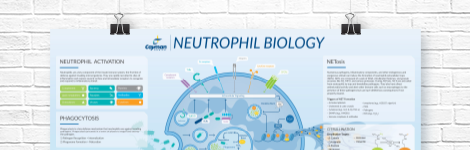
Neutrophil Biology Wall Poster
Explore how neutrophils shape the immune response in health and disease. This poster highlights neutrophil pathogen defense mechanisms, including phagocytosis, degranulation, and NETosis, as well as neutrophil roles in inflammation and NET-associated pathologies.
DOWNLOAD NOWProduct Description
FSL-1 is a synthetic lipopeptide agonist of toll-like receptor 2 (TLR2) and TLR6 heterodimers (TLR2/TLR6).1,2 In HEK293 cells transfected with human TLR2 and TLR6 but not TLR6 alone, FSL-1 increases NF-κB activity by 4- and 8-fold when used at concentrations of 0.1 and 1 nM, respectively.1 It induces the expression of the cytokines CCL20, IL-8, IL-1β, and TNF-α in human monocytic THP-1 cells and, to a lesser extent, in TLR10 knockdown cells when used at a concentration of 100 ng/ml.3 FSL-1 (0.5-50 μg/ml), in combination with IFN-γ, dose-dependently increases the percentage of DM13 and VMM1 melanoma cells expressing the chemokine CXCL10 with a maximal increase of approximately 50%.4 In rats, FSL-1 (100 μg/kg, i.p.) induces fever and increases plasma levels of IL-6 and TNF-α by greater than 90-fold.5 FSL-1 (10-1,000 μg/kg, i.p.) also dose-dependently reduces home cage locomotor activity and both food and water consumption with maximal reductions of ten grams per 12 hours.
WARNING This product is not for human or veterinary use.
References & Product Citations
1. Relationship between structures and biological activities of mycoplasmal diacylated lipopeptides and their recognition by toll-
2. Heterodimerization of TLR2 with TLR1 or TLR6 expands the ligand spectrum but does not lead to differential signaling. J. Leukoc. Biol. 83(3), 692-701 (2008).
3. Stable Toll-
4. TLR2/6 agonists and interferon-
5. Pyrexia, anorexia, adipsia, and depressed motor activity in rats during systemic inflammation induced by the Toll-
Contact Info
Cayman Chemical1180 East Ellsworth RoadAnn Arbor, Michigan 48108 USAToll Free: (800) 364-9897(USA and Canada only)Fax: (734) 971-3640


