
Technical Support & Resources
Visit our FAQ
Contact Us
Toll Free Phone (USA and Canada Only): (888) 526-5351
Direct Phone: (734) 975-3888
Product Categories
Technical Information
- PAF-AH2
- HSD-PLA2
- Platelet-Activating Factor Acetylhydrolase 2, Cytoplasmic
- Serine-Dependent Phospholipase A2
Shipping & Storage Information
Recommended Products
Certificates of Analysis & Batch Specific Data
Provide batch numbers separated by commas to download or request available product inserts, QC sheets, certificates of analysis, data packs, and GC-MS data.
Lipid Resource Center
Discover Products & Resources for Lipid Research
- High-purity lipid standards
- Lipid roles in biology
- Lipids in health & disease
- Lipids for pharmaceutical development
- Protocols, advice, & resources
Product Description
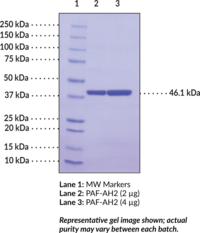
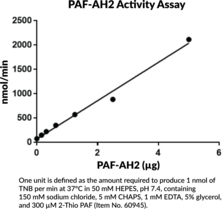
PAF acetylhydrolase 2 (PAF-AH2) is a serine-dependent, intracellular-type platelet-activating factor (PAF) acetylhydrolase that is expressed in a variety of tissue and cell types but is most abundant in the liver, kidney, testis, and intestines.1,2,3,4 It contains an N-terminal myristoylation site and can translocate from the cytosol to cellular membranes in response to various stressors including UVB radiation, LPS, or oxidative stress, during which PAF-AH2 localizes to the endoplasmic reticulum and Golgi apparatus.2,5 PAF-AH2 hydrolyzes and inactivates PAF, a phospholipid mediator involved in a variety of biological activities, including inflammation, smooth muscle contraction, and fetal development.2,3,6 It also hydrolyzes phospholipids with short-chain or oxidized fatty acids at the sn-2 position.1,2 PAF-AH2 has demonstrated protective activities in various in vitro and in vivo models of oxidative stress.2,4,5 Overexpression of PAF-AH2 reduces cytotoxicity and apoptosis induced by tert-butylhydroperoxide (t-BuOOH) in CHO-K1 cells.5 Conversely, PAF-AH2-deficient (Pafah2-/-) mouse embryonic fibroblasts (MEFs) are more susceptible to t-BuOOH-induced cell death than wild-type MEFs.4 In addition, Pafah2-/- mice exhibit increased hepatic necrosis compared to wild-type animals in a mouse model of carbon tetrachloride-induced hepatic injury.
WARNING This product is not for human or veterinary use.
References & Product Citations
1. Expression, purification and characterization of a human serine-
2. Intracellular platelet-
3. The emerging roles of PAF acetylhydrolase. J. Lipid Res. 50(Suppl), S255-S259 (2009).
4. Protection against oxidative stress-
5. Protection against oxidative stress-
6. cDNA cloning and expression of intracellular platelet-
Contact Info
Cayman Chemical1180 East Ellsworth RoadAnn Arbor, Michigan 48108 USAToll Free: (800) 364-9897(USA and Canada only)Fax: (734) 971-3640


