
Technical Support & Resources
Visit our FAQ
Contact Us
Toll Free Phone (USA and Canada Only): (888) 526-5351
Direct Phone: (734) 975-3888
Product Categories
Technical Information
- PADI3
- PDI3
- Peptidylarginine Deiminase 3
- Protein Arginine Deiminase 3
Shipping & Storage Information
Recommended Products
Certificates of Analysis & Batch Specific Data
Provide batch numbers separated by commas to download or request available product inserts, QC sheets, certificates of analysis, data packs, and GC-MS data.

Visit Our Cancer Resource Center
Find Tools & Resources to Study the Hallmarks of Cancer
- Cancer cell signaling & regulation
- Cancer metabolism
- Tumor microenvironment
Product Description
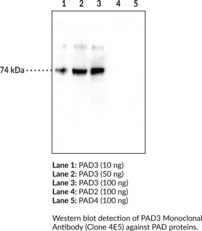
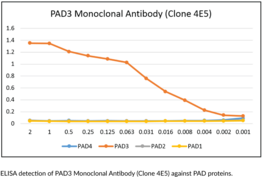
Protein arginine deiminase 3 (PAD3) catalyzes the conversion of arginine residues to citrulline within its cellular protein substrates, which include S100A3, trichohyalin, and filaggrin, resulting in the loss of a positive charge, which can alter protein structure and/or function.1 It exists as a homodimer and is composed of a C-terminal catalytic domain and an N-terminal domain that contains two immunoglobulin G (IgG) subdomains.2 PAD3 is primarily expressed by differentiated keratinocytes in the epidermis and hair follicles where it has roles in the shaping and mechanical strengthening of hair.2,3 It is also expressed by neural stem cells where it modulates cell death by regulating the nuclear translocation of apoptosis-inducing factor (AIF), in mammary glands where it citrullinates proteins during lactation, and cancer cells where it promotes cancer cell invasion.4,5,6 Mutations in PADI3 are associated with uncombable hair syndrome. Cayman's PAD3 Monoclonal Antibody (Clone 4E5) can be used for ELISA, Immunofluorescence (IF) and Western blot (WB) applications. The antibody recognizes PAD3 at ~74 kDa from human samples.
WARNING This product is not for human or veterinary use.
References & Product Citations
1. Peptidylarginine deiminase expression and activity in PAD2 knock-
2. Structures of human peptidylarginine deiminase type III provide insights into substrate recognition and inhibitor design. Arch. Biochem. Biophys. 708, 108911 (2021).
3. Mutations in three genes encoding proteins involved in hair shaft formation cause uncombable hair syndrome. Am. J. Cancer Res. 99(6), 1292-1304 (2016).
4. Modulation of calcium-
5. Peptidylarginine deiminase 3 (PAD3) is upregulated by prolactin stimulation of CID-
6. Peptidylarginine deiminase inhibitor application, using Cl-
Contact Info
Cayman Chemical1180 East Ellsworth RoadAnn Arbor, Michigan 48108 USAToll Free: (800) 364-9897(USA and Canada only)Fax: (734) 971-3640


