
An antimicrobial peptide
Technical Support & Resources

Information provided in the product description is from published literature. Due to the nature of scientific experimentation, your results (e.g., selectivity and effective concentrations) or specific application for this product may differ. If you have questions about how this product fits your application, please contact our technical support staff.

Visit our FAQ

Contact Us

Toll Free Phone (USA and Canada Only): (888) 526-5351
Direct Phone: (734) 975-3888

Request Technical Support

Technical Support Request

To streamline the process attach the appropriate questionnaire to your inquiry.

Download IHC QuestionnaireDownload WB Questionnaire

View Our Privacy Statement for details on how we use and protect your data. In addition, this site is protected by hCaptcha and its Privacy Policy and Terms of Service apply.

LL-37 (human) (trifluoroacetate salt)

Item No. 24461

Technical Information
Formal Name
L-leucyl-L-leucylglycyl-L-α-aspartyl-L-phenylalanyl-L-phenylalanyl-L-arginyl-L-lysyl-L-seryl-L-lysyl-L-α-glutamyl-L-lysyl-L-isoleucylglycyl-L-lysyl-L-α-glutamyl-L-phenylalanyl-L-lysyl-L-arginyl-L-isoleucyl-L-valyl-L-glutaminyl-L-arginyl-L-isoleucyl-L-lysyl-L-α-aspartyl-L-phenylalanyl-L-leucyl-L-arginyl-L-asparaginyl-L-leucyl-L-valyl-L-prolyl-L-arginyl-L-threonyl-L-α-glutamyl-L-serine, trifluoroacetate salt
Synonyms
  • CAP-18
  • hCAP-18
  • Cathelicidin
  • FALL-39
Molecular Formula
C205H340N60O53 • XCF3COOH
Formula Weight
Purity
≥95%
A lyophilized powder
Peptide Sequence
LLGDFFRKSKEKIGKEFKRIVQRIKDFLRNLVPRTES-OH
Water: 1 mg/ml
SMILES
[H]N[C@@H](CC(C)C)C(N[C@@H](CC(C)C)C(NCC(N[C@H](C(N[C@H](C(N[C@H](C(N[C@@H](CCCNC(N)=N)C(N[C@@H](CCCCN)C(N[C@@H](CO)C(N[C@@H](CCCCN)C(N[C@@H](CCC(O)=O)C(N[C@@H](CCCCN)C(N[C@]([C@H](CC)C)([H])C(NCC(N[C@@H](CCCCN)C(N[C@@H](CCC(O)=O)C(N[C@H](C(N[C@@H](CCCCN)C(N[C@@H](CCCNC(N)=N)C(N[C@]([C@H](CC)C)([H])C(N[C@@H](C(C)C)C(N[C@@H](CCC(N)=O)C(N[C@@H](CCCNC(N)=N)C(N[C@]([C@H](CC)C)([H])C(N[C@@H](CCCCN)C(N[C@H](C(N[C@H](C(N[C@@H](CC(C)C)C(N[C@@H](CCCNC(N)=N)C(N[C@@H](CC(N)=O)C(N[C@@H](CC(C)C)C(N[C@@H](C(C)C)C(N1CCC[C@H]1C(N[C@@H](CCCNC(N)=N)C(N[C@]([C@@H](C)O)([H])C(N[C@@H](CCC(O)=O)C(N[C@@H](CO)C(O)=O)=O)=O)=O)=O)=O)=O)=O)=O)=O)=O)CC2=CC=CC=C2)=O)CC(O)=O)=O)=O)=O)=O)=O)=O)=O)=O)=O)CC3=CC=CC=C3)=O)=O)=O)=O)=O)=O)=O)=O)=O)=O)=O)CC4=CC=CC=C4)=O)CC5=CC=CC=C5)=O)CC(O)=O)=O)=O)=O.FC(F)(C(O)=O)F
InChi Code
InChI=1S/C205H340N60O53.C2HF3O2/c1-20-114(16)162(261-179(296)128(66-40-46-86-211)235-176(293)135(74-78-155(273)274)243-170(287)125(63-37-43-83-208)241-192(309)148(106-266)257-174(291)126(64-38-44-84-209)234-171(288)129(67-47-87-225-201(215)216)240-185(302)142(98-119-55-29-24-30-56-119)252-187(304)144(100-121-59-33-26-34-60-121)253-189(306)146(102-158(279)280)233-154(272)104-230-167(284)138(94-109(6)7)248-166(283)122(212)93-108(4)5)194(311)231-105-153(271)232-123(61-35-41-81-206)168(285)242-136(75-79-156(275)276)177(294)251-141(97-118-53-27-23-28-54-118)184(301)238-124(62-36-42-82-207)169(286)236-131(69-49-89-227-203(219)220)181(298)263-164(116(18)22-3)197(314)259-160(112(12)13)195(312)246-134(73-77-151(213)269)175(292)237-132(70-50-90-228-204(221)222)180(297)262-163(115(17)21-2)196(313)245-127(65-39-45-85-210)172(289)256-147(103-159(281)282)190(307)254-143(99-120-57-31-25-32-58-120)186(303)249-139(95-110(8)9)183(300)239-130(68-48-88-226-202(217)218)173(290)255-145(101-152(214)270)188(305)250-140(96-111(10)11)191(308)260-161(113(14)15)199(316)265-92-52-72-150(265)193(310)244-133(71-51-91-229-205(223)224)182(299)264-165(117(19)268)198(315)247-137(76-80-157(277)278)178(295)258-149(107-267)200(317)318;3-2(4,5)1(6)7/h23-34,53-60,108-117,122-150,160-165,266-268H,20-22,35-52,61-107,206-212H2,1-19H3,(H2,213,269)(H2,214,270)(H,230,284)(H,231,311)(H,232,271)(H,233,272)(H,234,288)(H,235,293)(H,236,286)(H,237,292)(H,238,301)(H,239,300)(H,240,302)(H,241,309)(H,242,285)(H,243,287)(H,244,310)(H,245,313)(H,246,312)(H,247,315)(H,248,283)(H,249,303)(H,250,305)(H,251,294)(H,252,304)(H,253,306)(H,254,307)(H,255,290)(H,256,289)(H,257,291)(H,258,295)(H,259,314)(H,260,308)(H,261,296)(H,262,297)(H,263,298)(H,264,299)(H,273,274)(H,275,276)(H,277,278)(H,279,280)(H,281,282)(H,317,318)(H4,215,216,225)(H4,217,218,226)(H4,219,220,227)(H4,221,222,228)(H4,223,224,229);(H,6,7)/t114-,115-,116-,117+,122-,123-,124-,125-,126-,127-,128-,129-,130-,131-,132-,133-,134-,135-,136-,137-,138-,139-,140-,141-,14
InChi Key
PYYXIYGCAXMCME-YLLLKHBJSA-N
Shipping & Storage Information
Storage
-20°C
Shipping
Room temperature in continental US; may vary elsewhere
Recommended Products

Certificates of Analysis & Batch Specific Data

Provide batch numbers separated by commas to download or request available product inserts, QC sheets, certificates of analysis, data packs, and GC-MS data.
    Add

    Add

    Cayman Chemical
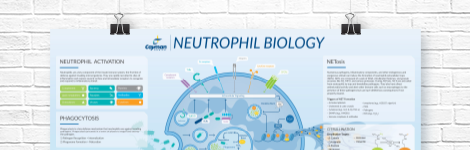
    Neutrophil Biology Wall Poster

    Explore how neutrophils shape the immune response in health and disease. This poster highlights neutrophil pathogen defense mechanisms, including phagocytosis, degranulation, and NETosis, as well as neutrophil roles in inflammation and NET-associated pathologies.

    DOWNLOAD NOW
    Product Description

    LL-37 is a cationic and α-helical antimicrobial peptide expressed in human bone marrow, testis, granulocytes, and gingival epithelium and is upregulated in psoriatic lesions.1 It inhibits growth of Gram-positive E. coli D21 and Gram-negative B. megatarium in a concentration-dependent manner and LL-37 expression is induced in A549 epithelial cells, alveolar macrophages, neutrophils, and monocyte-derived macrophages following M. tuberculosis infection.1,2,3 LL-37 binds sheep erythrocytes coated with S. minnesota Re-LPS and induces agglutination with a minimal agglutinating concentration (MAC) of 12.1 μg/ml.4 It is a chemoattractant for, and can induce calcium mobilization in, human monocytes, neutrophils, and T cells that naturally express formyl peptide receptor-like 1 (FPRL1) and FPRL1-transfected HEK293 cells.5 LL-37 (10-15 μM) pretreatment of dengue virus type 2 (DENV-2) reduces its infectivity as well as levels of viral genomic RNA and NS1 antigen.6 In vivo, LL-37 inhibits cecal ligation and puncture-induced caspase-1 activation and pyroptosis of peritoneal macrophages, reduces levels of the inflammatory cytokines IL-1β, IL-6, and TNF-α, and improves survival in polybacterial septic mice.7

    WARNING This product is not for human or veterinary use.

    References & Product Citations
    Product Description References

    1. Weinberg, A., Krisanaprakornkit, S., and Dale, B.A. Epithelial antimicrobial peptides: Review and significance for oral applications. Crit. Rev. Oral Biol. Med. 9(4), 399-414 (1998).

    2. Rivas-Santiago, B., Hernandez-Pando, R., Carranza, C., et alExpression of cathelicidin LL-37 during Mycobacterium tuberculosis infection in human alveolar macrophages, monocytes, neutrophils, and epithelial cells. Infect. Immun. 76(3), 935-941 (2008).

    3. Gudmundsson, G.H., Agerberth, B., Odeberg, J., et alThe human gene FALL39 and processing of the cathelin precursor to the antibacterial peptide LL-37 in granulocytes. Eur. J. Biochem. 238(2), 325-332 (1996).

    4. Larrick, J.W., Hirata, M., Balint, R.F., et alHuman CAP18: A novel antimicrobial lipopolysaccharide-binding protein. Infect. Immun. 63(4), 1291-1297 (1995).

    5. Yang, B.D., Chen, Q., Schmidt, A.P., et alLL-37, the neutrophil granule- and epithelial cell-derived cathelicidin, utilizes formyl peptide receptor-like 1 (FPRL1) as a receptor to chemoattract human peripheral blood neutrophils, monocytes, and T cells. J. Exp. Med. 192(7), 1069-1074 (2000).

    6. Alagarasu, K., Patil, P.S., Shil, P., et alIn-vitro effect of human cathelicidin antimicrobial peptide LL-37 on dengue virus type 2. Peptides 92, 23-30 (2017).

    7. Hu, Z., Murakami, T., Suzuki, K., et alAntimicrobial cathelicidin peptide LL-37 inhibits the pyroptosis of macrophages and improves the survival of polybacterial septic mice. Int. Immunol. 28(5), 245-253 (2016).

