
Technical Support & Resources
Information provided in the product description is from published literature. Due to the nature of scientific experimentation, your results (e.g., selectivity and effective concentrations) or specific application for this product may differ. If you have questions about how this product fits your application, please contact our technical support staff.
Visit our FAQ
Contact Us
Toll Free Phone (USA and Canada Only): (888) 526-5351
Direct Phone: (734) 975-3888
Product Categories
Research Area
Prion Protein (106-126) (trifluoroacetate salt)
Item No. 24556
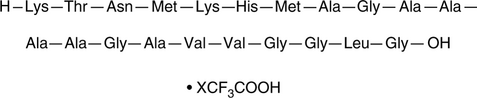
Technical Information
- PrP
Shipping & Storage Information
Recommended Products
Certificates of Analysis & Batch Specific Data
Provide batch numbers separated by commas to download or request available product inserts, QC sheets, certificates of analysis, data packs, and GC-MS data.
Product Description
Prion Protein (106-126) is a peptide fragment of the cellular prion protein PrPc.1 It forms fibrils that are organized into β-strands, a behavior characteristic of amyloids. It is toxic to primary rat hippocampal neurons at a concentration of 80 μM following incubation for 10 days and induces DNA fragmentation and apoptosis. Prion Protein (106-126) (25 μM) activates ERK1 and 2, p38, and JNK1 and 2 kinases, induces apoptosis, increases NADPH oxidase-dependent production of reactive oxygen species (ROS), and decreases glutathione (GSH) levels in 1C115-HT serotonergic and 1C11NE noradrenergic differentiated neuronal cells.2 It forms channels in lipid bilayer membranes that are freely permeable to calcium, sodium, potassium, lithium, rubidium, cesium, and chloride ions at a concentration of 20 μM, and channel formation is significantly enhanced by aging and low pH.3 In vivo, intraocular injection of prion protein (106-126) (1 mM) increases the number of terminal deoxynucleotidyltransferase-mediated dUTP nick end labeling (TUNEL) positive nuclei in mice 4 days post injection.4
WARNING This product is not for human or veterinary use.
References & Product Citations
1. Neurotoxicity of a prion protein fragment. Nature 362(6420), 543-546 (1993).
2. Overstimulation of PrPC signaling pathways by prion peptide 106-
3. Channel formation by a neurotoxic prion protein fragment. The Journal of Biological Chemisty 272(1), 44-47 (1997).
4. Amidation and structure relaxation abolish the neurotoxicity of the prion peptide PrP106-
Contact Info
Cayman Chemical1180 East Ellsworth RoadAnn Arbor, Michigan 48108 USAToll Free: (800) 364-9897(USA and Canada only)Fax: (734) 971-3640


