
Technical Support & Resources
Visit our FAQ
Contact Us
Toll Free Phone (USA and Canada Only): (888) 526-5351
Direct Phone: (734) 975-3888
Product Categories

Technical Information
- Heat Shock 84 kDa
- Hsp84
- Hsp86
- Heat Shock Protein 90
- LAP-2
- Lipopolysaccharide-associated Protein 2
- LPS-associated Protein 2
- Renal Carcinoma Antigen NY-REN-38
Shipping & Storage Information
Recommended Products
Certificates of Analysis & Batch Specific Data
Provide batch numbers separated by commas to download or request available product inserts, QC sheets, certificates of analysis, data packs, and GC-MS data.

Visit Our Cancer Resource Center
Find Tools & Resources to Study the Hallmarks of Cancer
- Cancer cell signaling & regulation
- Cancer metabolism
- Tumor microenvironment
Product Description
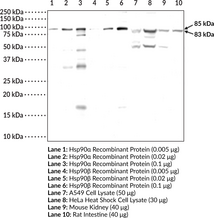
Hsp90 is a multidomain protein that functions as a molecular chaperone to assist in folding and activation of nascent peptides, refolding unfolded or misfolded proteins, and preventing protein aggregation.1 Hsp90α is the inducible cytosolic isoform of Hsp90 while Hsp90β is the constitutively active cytosolic isoform. Hsp90α and β are encoded by HSP90AA and HSP90AB, respectively in humans.2 C-terminal dimerization of Hsp90, coupled with ATPase molecular clamp activity induces a conformational change in the N-terminal nucleotide binding domain that facilitates substrate binding and initiates the chaperone cycle.3 Hsp90 interacts with many co-chaperones during its chaperone cycle including p23 and Sba1, which help recruit substrates to the Hsp90 complex, Hsp70 (Item Nos. 22739 | 23002), which loads nascent polypeptides onto the Hsp90 dimer, and the ATPase activator Aha1 that promotes ATP hydrolysis and substrate release.4,5 Hsp90 is overexpressed in cancer cells and stabilizes client proteins that promote oncogenesis, including transcription factors, signaling proteins, and kinases.2,5 Hsp90 also decreases α-synuclein fibril formation and toxicity as well as Q35 aggregation in in vitro models of Parkinson's and Huntington's disease, respectively, implying a role in neurodegenerative disease.6 Cayman's Hsp90α/β Polyclonal Antibody can be used for Western blot and ELISA applications. This antibody recognizes Hsp90α at 85 kDa and Hsp90β at 83 kDa from human, mouse, and rat samples.
WARNING This product is not for human or veterinary use.
References & Product Citations
1. Chaperone-
2. The HSP90 family of genes in the human genome: Insights into their divergence and evolution. Genomics 86(6), 627-637 (2005).
3. The ATPase cycle of Hsp90 drives a molecular “clamp” via transient dimerization of the N-
4. Crystal structure of an Hsp90-
5. Structure, function and regulation of the hsp90 machinery. Biomed. J. 36(3), 106-117 (2013).
6. The Hsp70/Hsp90 chaperone machinery in neurodegenerative diseases. Front. Neurosci. 11:254, (2017).
Contact Info
Cayman Chemical1180 East Ellsworth RoadAnn Arbor, Michigan 48108 USAToll Free: (800) 364-9897(USA and Canada only)Fax: (734) 971-3640


