
An antimicrobial peptide
Technical Support & Resources

Information provided in the product description is from published literature. Due to the nature of scientific experimentation, your results (e.g., selectivity and effective concentrations) or specific application for this product may differ. If you have questions about how this product fits your application, please contact our technical support staff.

Visit our FAQ

Contact Us

Toll Free Phone (USA and Canada Only): (888) 526-5351
Direct Phone: (734) 975-3888

Request Technical Support

Technical Support Request

To streamline the process attach the appropriate questionnaire to your inquiry.

Download IHC QuestionnaireDownload WB Questionnaire

View Our Privacy Statement for details on how we use and protect your data. In addition, this site is protected by hCaptcha and its Privacy Policy and Terms of Service apply.

Defensin HNP-2 (human) (trifluoroacetate salt)

Item No. 24571
Technical Information
Formal Name
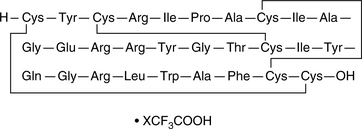
L-cysteinyl-L-tyrosyl-L-cysteinyl-L-arginyl-L-isoleucyl-L-prolyl-L-alanyl-L-cysteinyl-L-isoleucyl-L-alanylglycyl-L-α-glutamyl-L-arginyl-L-arginyl-L-tyrosylglycyl-L-threonyl-L-cysteinyl-L-isoleucyl-L-tyrosyl-L-glutaminylglycyl-L-arginyl-L-leucyl-L-tryptophyl-L-alanyl-L-phenylalanyl-L-cysteinyl-L-cysteine cyclic (1→29),(3→18),(8→28)-tris(disulfide), trifluoroacetate salt
Synonyms
  • DEFA2 Protein
  • α-Defensin 2
  • Human Neutrophil Peptide 2
  • Neutrophil Defensin 2
Molecular Formula
C147H217N43O37S6 • XCF3COOH
Formula Weight
Purity
≥95%
A lyophilized powder
Water: 1 mg/ml
SMILES
[H]N[C@H](C(N[C@H](C(N[C@H](C(N[C@@H](CCCNC(N)=N)C(N[C@]([C@H](CC)C)([H])C(N1CCC[C@H]1C(N[C@H](C(N[C@H](C(N[C@]([C@H](CC)C)([H])C(N[C@H](C(NCC(N[C@@H](CCC(O)=O)C(N[C@@H](CCCNC(N)=N)C(N[C@@H](CCCNC(N)=N)C(N[C@H](C(NCC(N[C@]([C@@H](C)O)([H])C2=O)=O)=O)CC3=CC=C(O)C=C3)=O)=O)=O)=O)=O)C)=O)=O)CSSC[C@H](N4)C5=O)=O)C)=O)=O)=O)=O)CSSC[C@H](N2)C(N[C@]([C@H](CC)C)([H])C(N[C@H](C(N[C@@H](CCC(N)=O)C(NCC(N[C@@H](CCCNC(N)=N)C(N[C@@H](CC(C)C)C(N[C@H](C(N[C@H](C(N[C@H](C4=O)CC6=CC=CC=C6)=O)C)=O)CC7=CNC8=C7C=CC=C8)=O)=O)=O)=O)=O)CC9=CC=C(O)C=C9)=O)=O)=O)CC%10=CC=C(O)C=C%10)=O)CSSC[C@H](N5)C(O)=O.OC(C(F)(F)F)=O
InChi Code
InChI=1S/C147H217N43O37S6.C2HF3O2/c1-13-73(6)114-139(222)168-76(9)118(201)163-63-110(196)170-96(48-50-113(199)200)127(210)172-92(31-22-52-159-145(152)153)125(208)171-93(32-23-53-160-146(154)155)126(209)178-98(58-81-35-41-85(192)42-36-81)123(206)165-65-112(198)186-117(79(12)191)141(224)184-106-70-232-229-67-103-134(217)173-94(33-24-54-161-147(156)157)128(211)189-116(75(8)15-3)142(225)190-55-25-34-108(190)138(221)167-78(11)120(203)181-105(136(219)187-114)69-231-230-68-104(135(218)185-107(143(226)227)71-233-228-66-89(148)121(204)176-100(133(216)182-103)59-82-37-43-86(193)44-38-82)183-132(215)99(57-80-26-17-16-18-27-80)175-119(202)77(10)166-129(212)102(61-84-62-162-90-29-20-19-28-88(84)90)179-130(213)97(56-72(4)5)177-124(207)91(30-21-51-158-144(150)151)169-111(197)64-164-122(205)95(47-49-109(149)195)174-131(214)101(60-83-39-45-87(194)46-40-83)180-140(223)115(74(7)14-2)188-137(106)220;3-2(4,5)1(6)7/h16-20,26-29,35-46,62,72-79,89,91-108,114-117,162,191-194H,13-15,21-25,30-34,47-61,63-71,148H2,1-12H3,(H2,149,195)(H,163,201)(H,164,205)(H,165,206)(H,166,212)(H,167,221)(H,168,222)(H,169,197)(H,170,196)(H,171,208)(H,172,210)(H,173,217)(H,174,214)(H,175,202)(H,176,204)(H,177,207)(H,178,209)(H,179,213)(H,180,223)(H,181,203)(H,182,216)(H,183,215)(H,184,224)(H,185,218)(H,186,198)(H,187,219)(H,188,220)(H,189,211)(H,199,200)(H,226,227)(H4,150,151,158)(H4,152,153,159)(H4,154,155,160)(H4,156,157,161);(H,6,7)/t73-,74-,75-,76-,77-,78-,79+,89-,91-,92-,93-,94-,95-,96-,97-,98-,99-,100-,101-,102-,103-,104-,105-,106-,107-,108-,114-,115-,116-,117-;/m0./s1
InChi Key
PLDZPWOITNALOZ-QEXVJSNTSA-N
Shipping & Storage Information
Storage
-20°C
Shipping
Room temperature in continental US; may vary elsewhere
Recommended Products

Certificates of Analysis & Batch Specific Data

Provide batch numbers separated by commas to download or request available product inserts, QC sheets, certificates of analysis, data packs, and GC-MS data.
    Add

    Cayman Chemical
    Neutrophil Biology Wall Poster

    Explore how neutrophils shape the immune response in health and disease. This poster highlights neutrophil pathogen defense mechanisms, including phagocytosis, degranulation, and NETosis, as well as neutrophil roles in inflammation and NET-associated pathologies.

    DOWNLOAD NOW
    Product Description

    Defensin HNP-2 is a peptide with antimicrobial properties that is secreted by human polymorphonuclear leukocytes (PMNs).1 It induces 26.2 and 43.5% lysis of mammalian cells at concentrations of 25 and 100 μg/ml, respectively.2 It also completely inhibits secretion of the exotoxin superantigen TSS toxin-1 (TSST-1) from S. aureus at a concentration of 5 ng/ml and inhibits infection of McCoy cells by C. trachomatis elementary bodies (EBs).3,4 Defensin HNP-2 binds to recombinant HIV-1 envelope glycoprotein gp120 and human CD4 (Kds = 8 and 15.8 nM, respectively).5 It also induces permeabilization of large unilamellar vesicles (LUVs) formed from 1-palmitoyl-2-oleoyl-sn-glycero-3-PG (POPG; Item No. 15105).6

    WARNING This product is not for human or veterinary use.

    References & Product Citations
    Product Description References

    1. Lehrer, R.I. Primate defensins. Nat. Rev. Microbiol. 2(9), 727-738 (2004).

    2. Lichtenstein, A., Ganz, T., Selsted, M.E., et alIn vitro tumor cell cytolysis mediated by peptide defensins of human and rabbit granulocytes. Blood 68(6), 1407-1410 (1986).

    3. Merriman, J.A., Nemeth, K.A., and Schlievert, P.M. Novel antimicrobial peptides that inhibit gram positive bacterial exotoxin synthesis. PLoS One 9(4), (2014).

    4. Yasin, B., Harwig, S.S.L., Lehrer, R.I., et alSusceptibility of Chlamydia trachomatis to protegrins and defensins. Infect. Immun. 64(3), 709-713 (1996).

    5. Wang, W., Owen, S.M., Rudolph, D.L., et alActivity of ɑ- and θ-defensins against primary isolates of HIV-1. J. Immunol. 173(1), 515-520 (2004).

    6. Wimley, W.C., Selsted, M.E., and White, S.H. Interactions between human defensins and lipid bilayers: Evidence for formation of multimeric pores. Protein Sci. 3(9), 1362-1373 (1994).

