
Technical Support & Resources
Information provided in the product description is from published literature. Due to the nature of scientific experimentation, your results (e.g., selectivity and effective concentrations) or specific application for this product may differ. If you have questions about how this product fits your application, please contact our technical support staff.
Visit our FAQ
Contact Us
Toll Free Phone (USA and Canada Only): (888) 526-5351
Direct Phone: (734) 975-3888
Product Categories
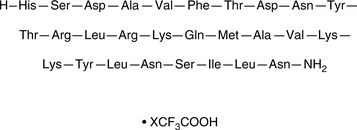
VIP (human, porcine, rat, ovine) (trifluoroacetate salt)
Item No. 24996
Technical Information
- Vasoactive Intestinal Peptide
Shipping & Storage Information
Recommended Products
Certificates of Analysis & Batch Specific Data
Provide batch numbers separated by commas to download or request available product inserts, QC sheets, certificates of analysis, data packs, and GC-MS data.
Neutrophil Biology Wall Poster
Explore how neutrophils shape the immune response in health and disease. This poster highlights neutrophil pathogen defense mechanisms, including phagocytosis, degranulation, and NETosis, as well as neutrophil roles in inflammation and NET-associated pathologies.
DOWNLOAD NOWProduct Description
Vasoactive intestinal peptide (VIP) is a 28-amino acid peptide that has roles as a hormone and neurotransmitter and has diverse biological activities, including roles in vasodilation, inflammation, and metabolism, as well as regulation of the circadian rhythm.1 It is an agonist of vasoactive intestinal polypeptide receptor 1 (VPAC1) and VPAC2, inducing adenylate cyclase activity with EC50 values of 3 and 8 nM, respectively, in CHO cell membranes expressing the recombinant human receptors, and is selective for these receptors over proteasome assembly chaperone 1 (PAC1; Ki = 500-1,000 nM in radioligand binding assays).2,3 VIP (10-300 nM) induces relaxation of isolated human fundus or antrum circular smooth muscle strips precontracted with carbachol (carbamoylcholine; Item No. 14486).4 It reduces increases in gastric acid secretion and mucosal blood flow induced by the CCK2 receptor agonist pentagastrin (Item No. 28546) in conscious dogs when administered intravenously at a dose of 8 µg/kg.5 VIP (5-10 nmol/animal, i.p.) decreases serum and peritoneal lavage levels of TNF-α and IL-6 and reduces mortality in a mouse model of LPS-induced endotoxemia.6 It inhibits replication of severe acute respiratory syndrome coronavirus 2 (SARS-CoV-2) in Calu-3 human lung epithelial cells and isolated human peripheral blood monocytes.7 It also inhibits production of IL-6, IL-8, and TNF-α in SARS-CoV-2-infected Calcu-3 cells.
WARNING This product is not for human or veterinary use.
References & Product Citations
1. Recent advances in vasoactive intestinal peptide physiology and pathophysiology: Focus on the gastrointestinal system. F1000Res. 8, 1629 (2019).
2. Characterization of a novel VPAC1 selective agonist and identification of the receptor domains implicated in the carboxyl-
3. Pharmacology and functions of receptors for vasoactive intestinal peptide and pituitary adenylate cyclase-
4. Vasoactive intestinal peptide receptor subtypes and signalling pathways involved in relaxation of human stomach. Neurogastroenterol. Motil. 18(11), 1009-1018 (2006).
5. Comparison of vasoactive intestinal peptide (VIP) and secretin in gastric secretion and mucosal blood flow. Pflügers Arch. 361(2), 175-181 (1976).
6. Anti-
7. The neuropeptides VIP and PACAP inhibit SARS-
Contact Info
Cayman Chemical1180 East Ellsworth RoadAnn Arbor, Michigan 48108 USAToll Free: (800) 364-9897(USA and Canada only)Fax: (734) 971-3640


