
Technical Support & Resources
Information provided in the product description is from published literature. Due to the nature of scientific experimentation, your results (e.g., selectivity and effective concentrations) or specific application for this product may differ. If you have questions about how this product fits your application, please contact our technical support staff.
Visit our FAQ
Contact Us
Toll Free Phone (USA and Canada Only): (888) 526-5351
Direct Phone: (734) 975-3888

Technical Information
- TF3
- TFDG
Shipping & Storage Information
Recommended Products
Certificates of Analysis & Batch Specific Data
Provide batch numbers separated by commas to download or request available product inserts, QC sheets, certificates of analysis, data packs, and GC-MS data.
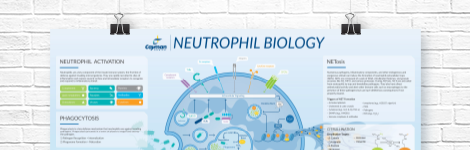
Neutrophil Biology Wall Poster
Explore how neutrophils shape the immune response in health and disease. This poster highlights neutrophil pathogen defense mechanisms, including phagocytosis, degranulation, and NETosis, as well as neutrophil roles in inflammation and NET-associated pathologies.
DOWNLOAD NOWProduct Description
Theaflavin-3,3'-digallate (TFDG) is a major polyphenol found in black tea with diverse biological activities.1,2,3 It has antioxidant activity, inhibiting the formation of superoxide radicals, singlet oxygen, hydrogen peroxide, and hydroxyl radicals in vitro (IC50s = 26.7, 0.83, 0.39, and 25.07 µmol/L, respectively).1 It also reduces hydroxyl radical-induced damage to plasmid DNA. TFDG (12.5-50 µM) prevents LPS-induced release of TNF-α, IL-1β, and IL-6, expression of JNK and p38, and nuclear translocation of NF-κB in RAW 264.7 cells.2 In vivo, TFDG reduces serum levels of TNF-α, IL-1β, and IL-6 and decreases pulmonary edema, pulmonary congestion, and thickening of the alveolar wall in a mouse model of LPS-induced acute lung injury. It also inhibits osteoclast formation, polarization, and osteoclastic bone resorption in vitro and reduces titanium particle-induced bone erosion and the number of mature osteoclasts in mice in a dose-dependent manner.3
WARNING This product is not for human or veterinary use.
References & Product Citations
1. Evaluation of the antioxidant effects of four main theaflavin derivatives through chemiluminescence and DNA damage analyses. J. Zhejiang. Univ. Sci. B. 12(9), 744-751 (2011).
2. In vitro and in vivo anti-
3. Theaflavin-
Contact Info
Cayman Chemical1180 East Ellsworth RoadAnn Arbor, Michigan 48108 USAToll Free: (800) 364-9897(USA and Canada only)Fax: (734) 971-3640


