
Technical Support & Resources
Visit our FAQ
Contact Us
Toll Free Phone (USA and Canada Only): (888) 526-5351
Direct Phone: (734) 975-3888
Product Categories
Technical Information
- Probable ATP-dependent RNA Helicase DDX58
- DEAD Box Protein 58
- Retinoic Acid-inducible Gene 1 Protein
- RIG-I-like Receptor 1
Shipping & Storage Information

Certificates of Analysis & Batch Specific Data
Provide batch numbers separated by commas to download or request available product inserts, QC sheets, certificates of analysis, data packs, and GC-MS data.

Visit Our Cancer Resource Center
Find Tools & Resources to Study the Hallmarks of Cancer
- Cancer cell signaling & regulation
- Cancer metabolism
- Tumor microenvironment
Product Description
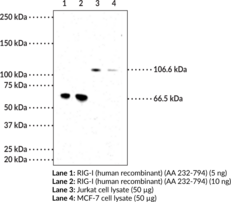
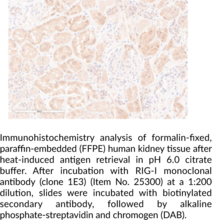
Retinoic acid-inducible gene I (RIG-I), also known as DDX58, is a cytosolic DExD/H-box RNA helicase and an immune sensing receptor encoded by DDX58 in humans.1 It is composed of a C-terminal repressor domain, a central RNA helicase domain, and two N-terminal caspase recruitment domains (CARDs).1,2 Following recognition of viral dsRNA by the C-terminal and helicase domains, the helicase domain induces an ATP-dependent conformational change, allowing for interaction of the CARD domains with mitochondrial antiviral-signaling protein (MAVS) and induction of a type I interferon (IFN) response.1,2,3 RIG-I levels are elevated in the epidermis of patients with psoriasis.2 DDX58 expression is decreased in tumor tissues from patients with hepatocellular carcinoma (HCC) compared to nontumor hepatic tissue, and low DDX58 expression is associated with poor disease prognosis.4 Cayman’s RIG-I Monoclonal Antibody (Clone 1E3) can be used for Western blot, ELISA, and immunohistochemistry applications. The antibody recognizes RIG-I at 106.6 kDa from human and mouse samples.
WARNING This product is not for human or veterinary use.
References & Product Citations
1. Nucleic acid immunity. Advances in Immunology 133, 121-169 (2017).
2. Function and regulation of retinoic acid-
3. Innate immunity to virus infection. Immunol. Rev. 277(1), 75-86 (2009).
4. Hepatic RIG-
Contact Info
Cayman Chemical1180 East Ellsworth RoadAnn Arbor, Michigan 48108 USAToll Free: (800) 364-9897(USA and Canada only)Fax: (734) 971-3640


