
Technical Support & Resources
Visit our FAQ
Contact Us
Toll Free Phone (USA and Canada Only): (888) 526-5351
Direct Phone: (734) 975-3888
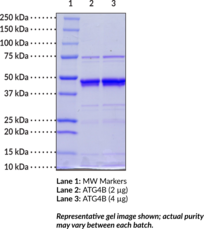
Technical Information
- AUT-like 1 Cysteine Endopeptidase
- Autophagin-1
- Autophagy-related Protein 4 Homolog B
- Cysteine Protease ATG4B
- hAPG4B
Shipping & Storage Information
Recommended Products
Certificates of Analysis & Batch Specific Data
Provide batch numbers separated by commas to download or request available product inserts, QC sheets, certificates of analysis, data packs, and GC-MS data.

Visit Our Cancer Resource Center
Find Tools & Resources to Study the Hallmarks of Cancer
- Cancer cell signaling & regulation
- Cancer metabolism
- Tumor microenvironment
Product Description
Autophagy-related 4B (ATG4B), also known as autophagin-1, is a cysteine protease and a member of the C54 protease family with dual roles in the progression of autophagy.1,2 It catalyzes the irreversible proteolytic cleavage of human homologs of yeast atg8 belonging to the microtubule-associated proteins 1 (MAP1)A/B-light chain 3 (LC3) and the GABA receptor-associated protein (GABARAP) subfamilies, including LC3, GATE16, GABARAP, and ATG8L, to expose a C-terminal glycine residue that is essential to formation of the autophagosome. It also catalyzes the reversible deconjugation of phosphatidylethanolamine from C-terminal glycine lipid-conjugated atg8 homologs.3 ATG4B expression is increased in CD34+ chronic myeloid leukemia (CML) stem and progenitor cells and knockdown of ATG4B expression increases accumulation of LC3-II and p62, indicating impaired autophagy, and reduces the viability and inhibits proliferation of CD34+ CML cells.4 Atg4-/- mice exhibit systemic decreases in basal and induced autophagy as well as increased susceptibility to colitis induced by dextran sodium sulfate (DSS) and pulmonary fibrosis induced by bleomycin (Item No. 13877).5,6
WARNING This product is not for human or veterinary use.
References & Product Citations
1. Kinetics comparisons of mammalian Atg4 homologues indicate selective preferences toward diverse Atg8 substrates. The Journal of Biological Chemisty 286(9), 7327-7338 (2011).
2. ATG4B (Autophagin-
3. LC3, GABARAP and GATE16 localize to autophagosomal membrane depending on form-
4. The core autophagy protein ATG4B is a potential biomarker and therapeutic target in CML stem/progenitor cells. Blood 123(23), 3622-3634 (2014).
5. ATG4B/autophagin-
6. Essential role for the ATG4B protease and autophagy in bleomycin-
Contact Info
Cayman Chemical1180 East Ellsworth RoadAnn Arbor, Michigan 48108 USAToll Free: (800) 364-9897(USA and Canada only)Fax: (734) 971-3640


