
Technical Support & Resources
Information provided in the product description is from published literature. Due to the nature of scientific experimentation, your results (e.g., selectivity and effective concentrations) or specific application for this product may differ. If you have questions about how this product fits your application, please contact our technical support staff.
Visit our FAQ
Contact Us
Toll Free Phone (USA and Canada Only): (888) 526-5351
Direct Phone: (734) 975-3888

Technical Information
Shipping & Storage Information
Recommended Products
Certificates of Analysis & Batch Specific Data
Provide batch numbers separated by commas to download or request available product inserts, QC sheets, certificates of analysis, data packs, and GC-MS data.
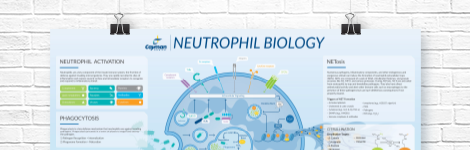
Neutrophil Biology Wall Poster
Explore how neutrophils shape the immune response in health and disease. This poster highlights neutrophil pathogen defense mechanisms, including phagocytosis, degranulation, and NETosis, as well as neutrophil roles in inflammation and NET-associated pathologies.
DOWNLOAD NOWProduct Description
Amprolium is a thiamine analog and antiprotozoal agent that interferes with thiamine metabolism and inhibits carbohydrate synthesis.1,2,3,4 It competitively inhibits thiamine uptake by E. tenella schizonts and by chick host intestinal cells (Kis = 7.6 and 326 μM, respectively).1 It also inhibits hexose formation and pentose utilization ex vivo in isolated lysed rat erythrocytes and in liver, kidney, heart, and intestinal tissue homogenates following dietary administration.2 Amprolium (1,000 ppm in feed) inhibits oocyst output and sporulation of Eimeria maxima, E. brunetti, and E. acervulina in infected chicks.3 It also decreases lesion and oocyst scores and mortality of E. tenella-infected chicks following dietary administration of a 125 ppm dose.4 Amprolium (100 μM) induces apoptosis in PC12 rat adrenal cells and increases the level of cleaved caspase-3.5 Formulations containing amprolium have been used as coccidiostats in poultry processing.
WARNING This product is not for human or veterinary use.
References & Product Citations
1. Thiamine uptake in isolated schizonts of Eimeria tenella and the inhibitory effects of amprolium. Parasitology 80(2), 313-322 (1980).
2. The antithiamine effects of amprolium in rats on tissue transketolase activity. Toxicol. Appl. Pharmacol. 6(4), 454-458 (1964).
3. The anticoccidial effects of amprolium, dinitolmide and monensin against Eimeria maxima, E. brunetti and E. acervulina with particular reference to oocyst sporulation. Parasitology 75(2), 155-164 (1977).
4. Anticoccidial activity of hydrochloric acid (HCl) against Eimeria tenella in broiler chickens. Pesq. Vet. Bras. 31(5), 425-429 (2011).
5. Thiamine deficiency caused by thiamine antagonists triggers upregulation of apoptosis inducing factor gene expression and leads to caspase 3-
Contact Info
Cayman Chemical1180 East Ellsworth RoadAnn Arbor, Michigan 48108 USAToll Free: (800) 364-9897(USA and Canada only)Fax: (734) 971-3640


