
Technical Support & Resources
Visit our FAQ
Contact Us
Toll Free Phone (USA and Canada Only): (888) 526-5351
Direct Phone: (734) 975-3888
Technical Information
- NF-κB-Activating Kinase
- Serine/Threonine-Protein Kinase TBK1
- TANK-Binding Kinase 1
Shipping & Storage Information
Recommended Products
Certificates of Analysis & Batch Specific Data
Provide batch numbers separated by commas to download or request available product inserts, QC sheets, certificates of analysis, data packs, and GC-MS data.
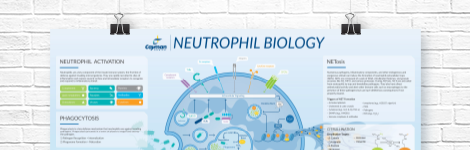
Neutrophil Biology Wall Poster
Explore how neutrophils shape the immune response in health and disease. This poster highlights neutrophil pathogen defense mechanisms, including phagocytosis, degranulation, and NETosis, as well as neutrophil roles in inflammation and NET-associated pathologies.
DOWNLOAD NOWProduct Description
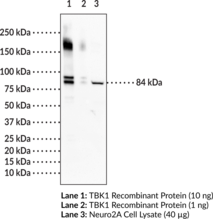
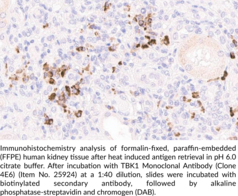
TANK-binding kinase 1 (TBK1) is a non-canonical inhibitor of NF-κB kinase (IKK) that has an essential role in regulating inflammatory responses to pathogens.1 Following activation of toll-like receptors by viral DNA, TBK1 interacts with various partners such as STING, MAVS, and TANK to phosphorylate and activate interferon regulatory factors (IRFs) 3 and 7 as well as DEAD-box helicase 3 X-linked (DDX3X), which leads to transcriptional activation of pro-inflammatory and antiviral genes including interferon (IFN) subtypes α and β.1,2 TBK1 induces nuclear translocation of NF-κB to initiate a pro-inflammatory response via phosphorylation of NF-κB inhibitor α (NFκBIα), IKKβ, or NF-κB p65 subunit (RelA).3 Cytosolic localization of E. coli, Salmonella, and S. pyogenes increases in TBK1-/- murine embryonic fibroblasts, macrophages, and epithelial cells, suggesting TBK1 maintains vacuolar integrity, which is critical to bacterial clearance.4 TBK1 phosphorylates the autophagy receptor optineurin to enhance binding of ubiquitin-like microtubule-associated protein light chain 3 (LC3) modifiers and induce autophagic clearance of S. enterica.5 It also binds to severe acute respiratory syndrome coronavirus 2 (SARS-CoV-2) non-structural protein 13 (Nsp13), a helicase-triphosphatase and component of the viral replicase-transcriptase complex.6 Cayman’s TBK1 Monoclonal Antibody (Clone 4E6) can be used for ELISA, Immunohistochemistry (IHC), and Western blot (WB) applications. The antibody recognizes TBK1 at approximately 84 kDa.
WARNING This product is not for human or veterinary use.
References & Product Citations
1. NF-
2. STING specifies IRF3 phosphorylation by TBK1 in the cytosolic DNA signaling pathway. Sci. Signal 5(214), ra20 (2012).
3. NAK is an IkB kinase-
4. TBK1 protects vacuolar integrity during intracellular bacterial infection. PLoS Pathog. 3(3), e29 (2007).
5. Phosphorylation of the autophagy receptor optineurin restricts Salmonella growth. Science 333(6039), 228-233 (2011).
6. A SARS-
Contact Info
Cayman Chemical1180 East Ellsworth RoadAnn Arbor, Michigan 48108 USAToll Free: (800) 364-9897(USA and Canada only)Fax: (734) 971-3640


