
Technical Support & Resources
Visit our FAQ
Contact Us
Toll Free Phone (USA and Canada Only): (888) 526-5351
Direct Phone: (734) 975-3888
Product Categories
Application
Technical Information
Shipping & Storage Information
Recommended Products
Certificates of Analysis & Batch Specific Data
Provide batch numbers separated by commas to download or request available product inserts, QC sheets, certificates of analysis, data packs, and GC-MS data.

Visit Our Cancer Resource Center
Find Tools & Resources to Study the Hallmarks of Cancer
- Cancer cell signaling & regulation
- Cancer metabolism
- Tumor microenvironment
Product Description
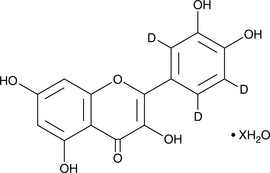
Quercetin-d3(hydrate) is intended for use as an internal standard for the quantification of quercetin (Item No. 10005169) by GC- or LC-MS. Quercetin is an abundant flavonoid that has been isolated from a variety of plants and has diverse biological activities, including antioxidant, anticancer, and anti-inflammatory properties.1,2,3 Quercetin (5-100 mg/kg) reduces autophagy, decreases the levels of reactive oxygen species (ROS) and malondialdehyde (MDA) content, and increases total antioxidant capacity in the kidney in a mouse model of cadmium-induced autophagy.2 It reduces tumor growth, induces apoptosis, and halts the cell cycle at the G1 phase in an HL60 mouse xenograft model when administered at a dose of 120 mg/kg every four days.1 Quercetin (30 µM) also inhibits histamine release from antigen-stimulated RBL-2H3 cells and decreases the expression of TNF-α, IL-1β, IL-6, and IL-8 induced by PMACI in HMC-1 cells.3
WARNING This product is not for human or veterinary use.
References & Product Citations
1. Antitumor activities of quercetin and green tea in xenografts of human leukemia HL60 cells. Sci. Rep. 8(1), 3459 (2018).
2. Quercetin inhibited cadmium-
3. Flavonoids inhibit histamine release and expression of proinflammatory cytokines in mast cells. Arch. Pharm. Res. 31(10), 1303-1311 (2008).
Contact Info
Cayman Chemical1180 East Ellsworth RoadAnn Arbor, Michigan 48108 USAToll Free: (800) 364-9897(USA and Canada only)Fax: (734) 971-3640


